Showing posts with label posted by Scott. Show all posts

Monday, December 16, 2013

My Experience with Milton

Literati at their finest.
To start off, I had to take this last opportunity to post a picture of Paradise Lost, the band that has plagued all of our research efforts.

Now on to the story of my paper. I didn't come up with the idea for my topic by any noble means. I just enjoy disagreeing with people. I thought that it was just too easy to read Adam as symbolic of humanity and asked myself, "why could that be wrong?" Since it's so much more fun to prove people wrong than it is to prove them right, I stuck with that topic and it turned into what I hope is a decent paper. (If not, I blame the Fall.)

Wednesday, December 11, 2013

Final Paper- Adam and the Individual

Posted the paper here on Google Docs. My computer is being a pain, so let me know in the comments if the link is broken or something is up.

Thanks everyone and good luck with wrapping up this semester.

Wednesday, November 20, 2013

Symbolic Readings of Adam

My working thesis is largely unchanged from my original paper:

"Although Adam and Eve are the first of the human race it is inaccurate to consider them as symbolic representations of the race as a whole by the way they think, feel, and behave in Milton's Paradise Lost. Misreading this symbolic representation interrupts Milton's concept of the Fall and its influence on mankind."

I am adding emphasis to the "so what?" side of the argument. What are the results of reading too much intoOn Education, in which Milton claims that we all have the responsibility to use knowledge and learning to overcome the fall. Therefore, if we just assume that we all are confined to a fallen state by Adam's actions, does that diminish our responsibility to work our way out of it? Did Milton believe that we were to be punished for Adam's transgression? (Even if he did, he probably doesn't anymore, if that spirit-world missionary work is chugging along as planned.)
the symbolism of our first parents and how does this fit in with Milton's theology? The main quote I will be working with comes from

I'm also considering spending time on the fallacies that lead to misreadings. For example, it is inaccurate to assume that simply because we share common characteristics with Adam, he must be symbolic of us. I am concerned that would result in being distracting from the driving thesis, however. Do you feel as though it will be detrimental to the paper and make it read more like a debate speech, or is it worth some exploration?


Monday, November 11, 2013

Milton's Vengeful God

As we've already discussed while reading Paradise Lost, God is considered one of the more distant characters. He has little dialogue and usually communicates with Adam via angels. There are times where God seems to be more than just ambiguous and borders on being spiteful.

For example, Milton makes it seem that God created mankind to show Satan that he is replaceable and not missed. Later, in Paradise Regained, Milton explains that Satan has even been allowed into heaven at times, as shown by his accusation of Job. Of course, we all know how well that went for Satan. God seems to have simply let the challenge happen for the sake of showing Satan that he really doesn't have nearly as much power and influence as he may have previously thought.

Monday, November 4, 2013

Adam and Humanity

Here is my paper. I had issues linking it to the blog before, so hopefully I didn't just post an empty link. I read through it about fifteen times, had roommates read it, and read it aloud, but I'm positive there are still several errors in there. That always happens to me. Thanks for your feedback and criticism working towards a finished project.

Wednesday, October 30, 2013

Adam and Humanity Pre-write

I'm still a little frustrated figuring out how to best work this argument, so any and all suggestions are welcome.

Thesis: Although Adam and Eve are the first of the human race, it is inaccurate to consider them as symbolic representations of the race as a whole by the way they think, feel, and behave in Milton's Paradise Lost.

Milton's beliefs in the acts of the individual and the timing of knowledge.
  1. Not all men are condemned to the fall/fate. Each has an individual choice and temptation that is separate from Adam's. Example- Abdiel's solitary return to the side of God.
  2. Areopagitica- God has endowed each of his children with reason and conscience and the ability to act for himself.
  3. Adam's sin was to seek knowledge before it was allotted him, but Milton sees knowledge as the redeeming power-- he writes in Of Education: "The end then of learning is to repair the ruins of our first parents by regaining to know God aright."
 Adam's traits/failures are his own and separate from other men.
  1. There are other members of the human race who are described as successfully keeping God's commandments, i.e. Enoch, Noah, Abraham in Books XI and XII.
  2. There are also members who are more rebellious than Adam during the Fall, such as Cain, whom Adam sees in Book XI.
  3. Therefore, the scope of humanity's potential for righteousness and wickedness is not represented by Adam and Eve's actions. 
Adam and Eve's experiences are exclusive and alienate them from the rest of their race.
  1. Adam and Eve are the only members of the race to have gone from Eden to a fallen world. 
  2. They only encounter through vision some of the great struggles of Milton's era (especially problems of politics and censorship.) In the visions Michael shows Adam, Adam feels distanced from his posterity.
  3. Adam and Eve can't function as paradigms of our race when they have extreme life experiences that are exclusive to only themselves.
I'm also considering exploring Milton's portrayal of Adam and Eve more as caricatures than characters and how this further distances them from the human experience.

Thoughts? Suggestions?


Monday, October 28, 2013

Discord, the Animals, and the Restored Gospel

Best to just let these two work things out on their own.
As a part of the forces of darkness invading earth, Milton talks about Discord causing the animals to be at conflict with one another, which for obvious reasons causes Adam distress. There are several scriptural passages that talk about the restoration of peace among the animal kingdom during the Millenial reign.

I had always assumed that it was the restoration of the earth to its celestial state that would cause the animals to return to their pre-Fall behavior. I came across an interesting article in the August 1972 Ensign, a section of which reads:

"During the Zion’s Camp expedition in the summer of 1834, an incident occurred that allowed a practical application of concern for animal life. As related by the Prophet Joseph Smith in his history:

Monday, October 21, 2013

Milton and Galileo

In Book 8 of Paradise Lost, Raphael gives Adam what seems to be a pretty uninformed explanation of the workings of celestial bodies. He finally tells Adam to "solicit not [his] thoughts with matters hid," but to instead "leave them to God above."

Up to this point in the poem, Milton hasn't seemed to have any problems being very direct on sensitive issues of doctrine. Why, then, does he hesitate to make a clear statement on the validity of geocentrism?


Wednesday, October 16, 2013

Areopagitica in Modern Court

Though published in 1644, Milton's Areopagitica still carries some significant political weight. Hundreds of years later, it has been quoted in United States Supreme Court cases at least four times: in each case it was used to define and defend the First Amendment right of free speech.

One famous case in which Milton was quoted is New York Times, Co. v. Sullivan. This case established that a party accusing another party of libel must be able to prove that the inaccuracy was printed with intended malice. The 19th footnote of the case transcription reads: "Even a false statement may be deemed to make a valuable contribution to public debate, since it brings about 'the clearer perception and livelier impression of truth, produced by its collision with error.'" The quote references Mill's On Liberty and Areopagitica.

Monday, October 14, 2013

Authorship and Censorship

Stanley Fish
In Stanley Fish's essay "How to Recognize a Poem When You See One," he writes an experience he had while teaching a class about religious poetry. In his previous class he had written five names on the chalkboard as a reading assignment. When the next class came in, instead of erasing the names, he asked them to analyze them as a poem (the students not knowing them as author's names). The students went to work on the poem, and eventually came up with an in-depth analysis of the five names. Fish's argument is that "it is not that the presence of poetic qualities that compels a certain kind of attention but that the paying of a certain kind of attention results in the emergence of poetic qualities" (par. 7)

Wednesday, October 9, 2013

Artist vs. Government

As we read Milton's tracts against the politics and policies of his time, I found it easy to agree with a lot that he had to say.  As I thought about why that is, I realized that most of the things Milton advocated are things that we have taken for granted, things that are a standard in our society today. I then asked myself, "how would we have reacted to Milton had we lived in his time?"

To explore this, I introduce an example of another literary polemicist who strikes a little closer to home for us. Ezra Pound (1885-1972) was an Idaho-born expatriate poet who is widely considered one of the greatest influences on modern poetry.

As you can see from the picture of Pound, he obviously was involved in much more than poetry. During World War II, he was living in Italy and publishing profusely. Most of his letters, articles, and radio broadcasts were construed as anti-American, so he was arrested and tried with treason during the Army's occupation of the country. While in captivity, he suffered a mental breakdown and was admitted to St. Elizabeth's mental hospital for 14 years.

Wednesday, October 2, 2013

Paradise Lost, the movie?

We've talked several times about the implausibility, if not impossibility, of a Paradise Lost movie. During my cyberspace wanderings I came across this fan-made trailer for a such a film.


Monday, September 30, 2013

Eliot and Milton

T. S. Eliot, widely considered one of Modernism's most important poets, is famous for his works such as The Love Song of J. Alfred Prufrock and The Wasteland. He published many very influential critical essays, at least two of which directly deal with Milton.

In the first, "A Note on Milton's Verse," he claims that what Milton did well he did better than any other writer, but that "the marks against him are both more numerous and more significant than the marks to his credit." Some of these marks against Milton include his strenuous adherence to traditional language and his verbose inefficiency. Many blame Eliot and his disciples for removing Milton from the forefront of literary thought and replacing him with Donne and the metaphysical poets.

Although Eliot would later revisit the subject and give Milton some credit he had denied him,

Wednesday, September 25, 2013

The Blind Prophets

Homer and his guide. William-Adolphe Bouguereau
As a student assistant for Brother Cowan, a blind professor who teaches here in the Church History and Doctrine area, I was intrigued by Milton's descriptions of his own blindness and poetic opinion of his limitations.
During his invocation at the beginning of the Third Book, Milton asks that he be blessed like other blind prophet poets to be able to perceive the things of God. He lists four names: Thamyris, Maeonides, Tiresias, and Phineus. I knew a little about a few of them, but was curious to learn more about their lives and why Milton chose to allude to them.
Thamyris is described in the Iliad as being a gifted poet/singer. Unfortunately, he was so confident in his abilities that he claimed he was a greater artist than the Muses themselves. To punish him for his pride, the Muses blinded him and robbed him of his talents, making him painfully aware that all inspiration and gifts can be taken by the Gods.
Maeonides is another name for Homer, the author of the Iliad and the Odyssey. Very little is known about Homer's life. Many translations of the Greek origins of his name

Wednesday, September 18, 2013

Elisha's Vision

For my sonnet I did a rendition of 2 Kings 6:13-17, which reads:

13 And he said, Go and spy where he is, that I may send and fetch him. And it was told him, saying, Behold, he is in Dothan.
14 Therefore sent he thither horses, and chariots, and a great host: and they came by night, and compassed the city about.
15 And when the servant of the man of God was risen early, and gone forth, behold, an host compassed the city both with horses and chariots. And his servant said unto him, Alas, my master! how shall we do?
16 And he answered, Fear not: for they that be with us are more than they that be with them.
17 And Elisha prayed, and said, Lord, I pray thee, open his eyes, that he may see. And the Lord opened the eyes of the young man; and he saw: and, behold, the mountain was full of horses and chariots of fire round about Elisha.

Monday, September 16, 2013

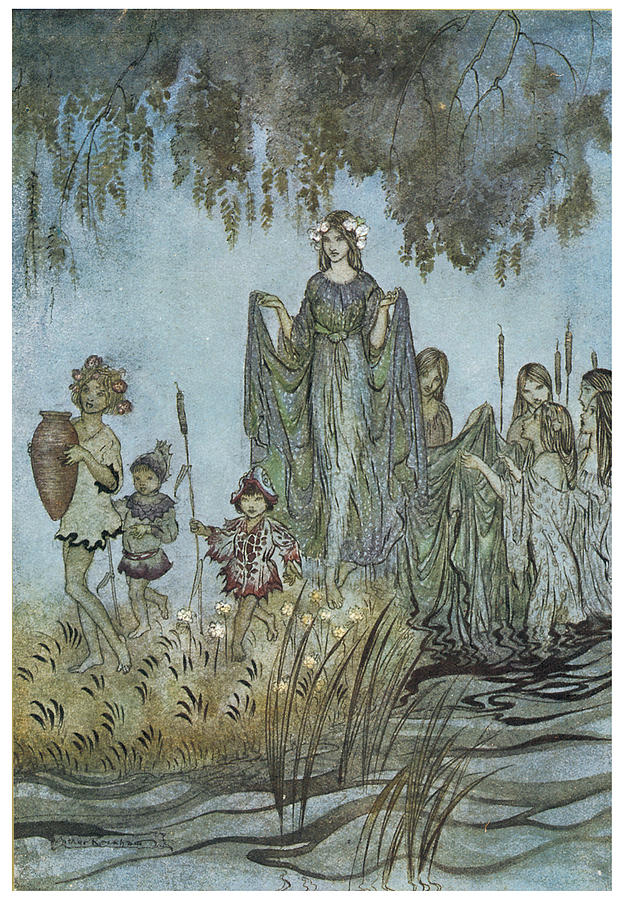
Sabrina and the Nymphs

We find another interesting example of Christian/Pagan synthesis in Milton's use of nymphs in his Comus. The story of Sabrina is a unique case, as it has figures from Greek mythology but is a British legend.
The nymphs of Greek mythology were minor deity. They are often portrayed as young, beautiful women and often classified by varying natural elements. (i.e. water, trees, air, etc.) They often interacted with major deity, and were capable of producing immortal offspring, though being mortal themselves. They are often portrayed as having strong powers over men. They certainly do not have the reputation of virtue and chastity, which is what makes their role in Comus an interesting one.
The legend of Sabrina originally appears in Geoffrey of Monmouth's Historia Regum Brittaniae, and tells of Hafren (or Habren) who was caught up in the typical war between powers fighting for the crown. Both her and her mother were drowned as political prisoners. She is then saved by the water nymphs and becomes one herself.
Knowing what we do about the nature of nymphs, why does Milton choose to use them to come to Lady's aid (especially in admiration of her virtue)? Does Milton completely disregard the mythological roots of these classic characters to suit his needs? The use of Sabrina could work to hearken the reader to the old British interpretation of the nymph character, but Milton's knowledge of Classic mythology makes it hard to ignore the original symbolism attached to these characters. 

Monday, September 9, 2013

Milton's Satan

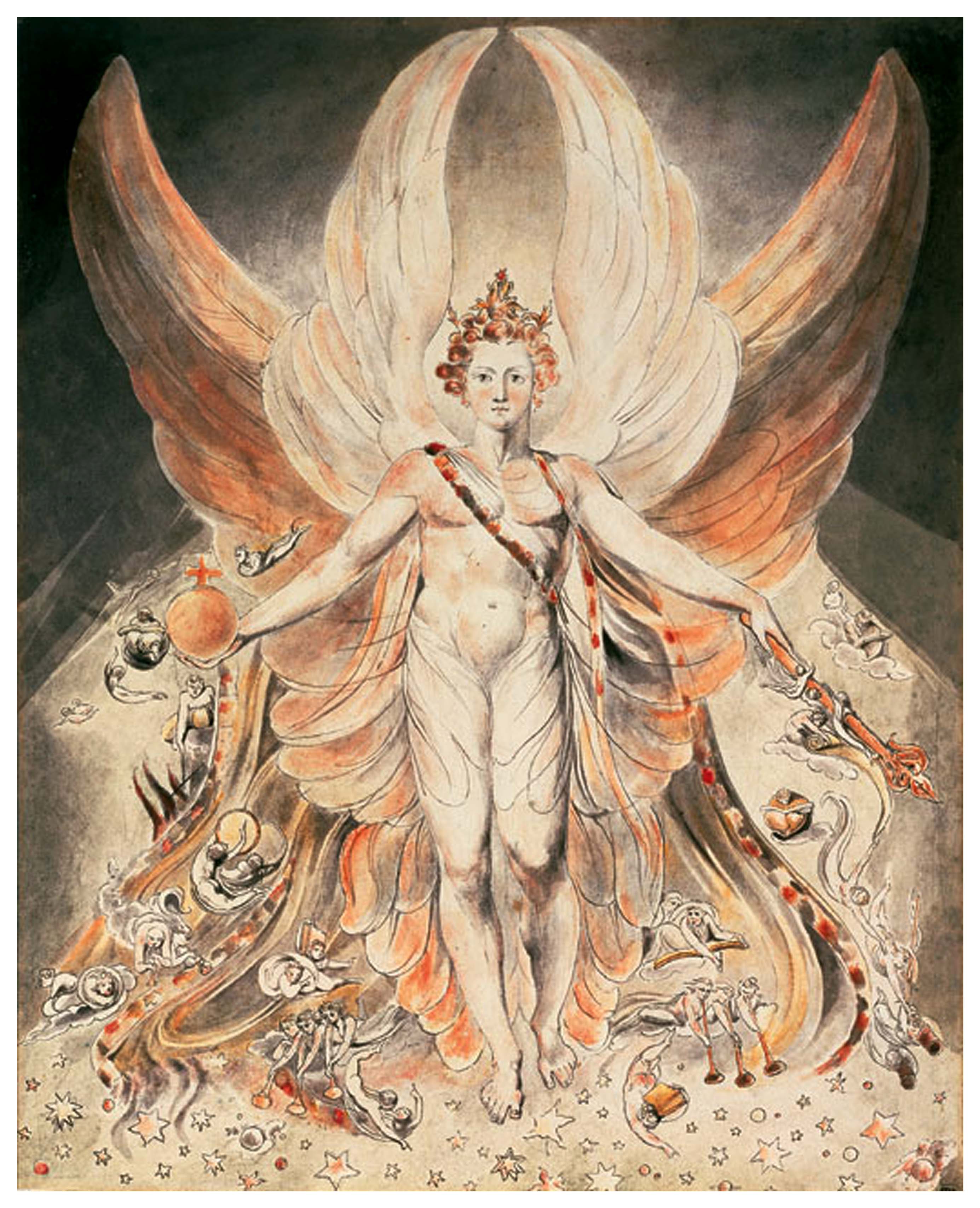
Satan in His Original Glory, by William Blake

     I have found in my reading that most scholars feel (and I agree) that Satan is the best written character in Paradise Lost. Many literary figures, including William Blake, argue that Satan is the true hero of Paradise Lost. (Here is a link to several thoughts on the subject by Blake and others-  http://www.cems.ox.ac.uk/citizenmilton/viii_heroism.shtml)
     What made Milton able to portray a Satan that is so universal? Why do some feel he is the most accessible character in the poem? After reading about Milton's life, I think that it is because Milton was more sympathetic with Satan than with any other character.
     Milton was fueled by ambition. He was determined to write the great English epic.He felt divinely appointed to be one of literature's greatest figures, and struggled with authority figures that tried to shape him differently. Magnify these characteristics-- the ambition, the eloquence, and the resistance to authority-- and we have Satan.
     I'm not making the claim that Milton was a Satanist. He obviously was a Christian who intended to perpetuate Christ's teachings through this work and other poetry. But I think that there is an interesting relationship between Milton and his Satan, and that Milton likely saw in himself (and humanity as a whole) the characteristics that caused Satan's downfall. This made him able to so convincingly portray a figure who constitutes a massive part of our theology.
     As the debate continues, maybe the truth is that Milton struggled just as much as the rest of us to define who the real tragic hero is in Paradise Lost.

I'm Scott.

I'm an English major. I love Pound, Eliot, and Nietzsche.

I'm the oldest of six kids and lifelong Utah resident. I served in the Florida Jacksonville Mission from 08-10, and miss it more and more all the time. I'm a huge movie fan and am really fond of spaghetti westerns, especially if they star Clint Eastwood.

I'm in this class for a few reasons. Simply put, I hate Shakespeare and would rather fill the requirement with Milton. I find Milton far more interesting and his works much more bearable. I enjoyed my first reading of Paradise Lost and am excited to see what I will learn through a deeper study.