Working Thesis: Milton’s use of classical allusions throughout his works and then refutal of them through Christ in “Paradise Regained” is in order to establish the view of Christ as the pinnacle of intellectual learning. We learn of all these things (Milton's upbringing and classical training), we copy them, imitate their works, trying to perfect them when in reality the image of perfection we should be striving for is Christ. Don’t let the copia and of these secular/classical writers get in the way. They are a means to an end. And Christ/Christianity (in its truest form) is that end.
(It is big, bumbling, and wordy but it gets the point across which is what I am most concerned about currently.)
Milton bends these traditions - by writing Paradise Lost as an epic, but turning it away from the traditional, pagan stories. In fact, he uses those stories to further his divine cause, to expand understanding of God and Christ.
Milton is using what people are familiar with in order to relay something new. Traditional forms but new content. Higher, elevated content. Christianity.
He is rendering into "common tongue” (of the time period, what people are familiar with.)
Milton’s sense of divine calling - it begins as an effort to justify the ways of God to man, Milton begins to realize that in order to justify these things we need to understand the nature of Christ. This explanation would qualify the disparity of characteristic between Paradise Lost and Paradise Regained. In Paradise Lost we are sucked into as Hillier describes "Milton’s Christocentric universe, charged with the Son’s grandeur.” The Son is treated with an awe-like deference. In Paradise Regained he becomes a person, a man, albeit an elevated one, but with a personality, characteristics, someone we could come to know. People care about him (Andrew & Simon, Mary.) And demons fear him (Satan…the other demons.) And that knowing, that coming to understand Him is what Milton feels he is called to call us to do.
What does this mean for all of those classical allusions?
Showing posts with label Christ. Show all posts
Showing posts with label Christ. Show all posts
Wednesday, November 20, 2013

Tuesday, November 19, 2013
Hunger and Consequences
So after much consideration and probably not quite enough research I've narrowed my original topic down quite a bit:
Thesis: In Paradise Lost and Paradise Regained Milton uses hunger, both physical and metaphorical, as the defining tool for character development in Satan and Christ respectively, ultimately illustrating the author's point that it is not circumstance which defines the individual, but how that individual chooses to act.
I'm still banging out a few obvious flaws, but I've ditched Adam and Eve to focus on Satan and Christ. I think this has the potential to shed some light on the dichotomy between these two principle characters, and I'm thinking I'll pull in some of Milton's other works where he characterizes them to draw parallels. I'm also still considering bringing in other figures in Milton's work who suffer from hunger.
Unfortunately I haven't quite figured out how to work actual food in. But the night is young, I may find a way yet.
 |
| And, since this is a really short post, here's how I feel about the autumn season. |
Thesis: In Paradise Lost and Paradise Regained Milton uses hunger, both physical and metaphorical, as the defining tool for character development in Satan and Christ respectively, ultimately illustrating the author's point that it is not circumstance which defines the individual, but how that individual chooses to act.
I'm still banging out a few obvious flaws, but I've ditched Adam and Eve to focus on Satan and Christ. I think this has the potential to shed some light on the dichotomy between these two principle characters, and I'm thinking I'll pull in some of Milton's other works where he characterizes them to draw parallels. I'm also still considering bringing in other figures in Milton's work who suffer from hunger.
Unfortunately I haven't quite figured out how to work actual food in. But the night is young, I may find a way yet.
Tuesday, November 12, 2013
What is Ambition: Milton's Look at Satan and Jesus
 Some things I noticed in Paradise Regained is the portrayal of Christ, and how Milton does it a little differently than in Paradise Lost. In Paradise Lost, Christ is the Son of God who fights against Satan and wins, returning to our Father in Heaven in triumph. However, in Paradise Regained, Christ is a little more vulnerable, showing human weakness, such as feeling hunger and having "dreamed, as appetite is wont to dream / of meats and drinks, nature's refreshment sweet." Milton seems to give Jesus more human qualities as he is now experiencing human temptations.
Another interesting thing is the reference to Christ's ambition. He states in book 1 that he entertained the thought of doing great things, saying, "victorious deeds / flamed in my heart, heroic acts, one while / to rescue Israel from the Roman yoke." Christ, much like Milton seeks to go beyond the usual mark, to do something heroic and achieve things "not yet attained." This reference to Christ's ambition interested me because I usually associated Milton's ambition to be likened to Satan's ambition in Paradise Lost. We linked Satan's ambition and pride to be his downfall. However, now that Christ seems to have ambitions and dreams, it causes me to have a second look at what is driving these characters and what is driving Milton.
I guess the question now is: what purpose does ambition serve? Is it alright to have ambition? Can Christ have ambition like Satan and still be the Son of God? I think maybe the difference that Milton manages to show between Christ and Satan in Paradise Regained is that while Christ, like Satan may have ambitions, he still answered to God. Perhaps where Satan went wrong is that he took it just a little too far. Perhaps that is why when Satan tries to tempt Christ, it doesn't work for a second because Christ has found that balance between ambition and obedience to God. That balance can never be obtained by Satan because he refuses to give a little of his ambitions and listen. It's an interesting thought, one that I hope to explore a little more in my paper.
Monday, November 11, 2013
Humility and "Active Passivity" in Paradise Regained

Wednesday, November 6, 2013
Christ and the Temptation
 Today's class discussion had me considering a question that was asked: Why did Milton choose the action for this sequel called Paradise Regained to be something that at first glance seems relatively minor? Why not make Paradise Regained the story of the Second Coming, or of the Crucifixion, or of the Resurrection? Why follow up such a grand epic like Paradise Lost, with such a small epic (while still giving it such a monumental sounding name like Paradise Regained)?
Looking at the text and considering a few things from Christian teachings, I believe that there are a couple of reasons for this. One reason for Milton choosing to tell this story of the temptations of Christ to explain how paradise was/is regained is the fact that this story immediately follows Jesus' confirmation by the Holy Spirit of God that he is the Son of God, thus making all his actions in that moment the first true test of his divinity.
Christ’s Awakening To Divinity

I’ve always
found it interesting to think about what Christ thought of himself as he grew
up. To what extent was he aware of his divinely appointed mission? What did he
know about his heritage and what did he not know? How did he feel as a youth
growing up, did he feel more mature, different than everyone around him? So
many interested questions that we have little to no knowledge about from
Biblical Accounts. We have accounts of Apostles writing about the divinity of
Christ but nothing written by Christ himself about his life or mission. In our
own Mormon literature, Jesus the Christ offers some insight into some of these possibilities
but beyond that we don’t have much.
The first chapter Paradise Regained offers an interesting
perspective on some of these questions in a narrative written from the perspective
of Christ. I think Milton did a fantastic job at diving into these questions
and creating a persona that I could see as a very possible reality for what the
young Jesus may have thought.
Wednesday, September 25, 2013
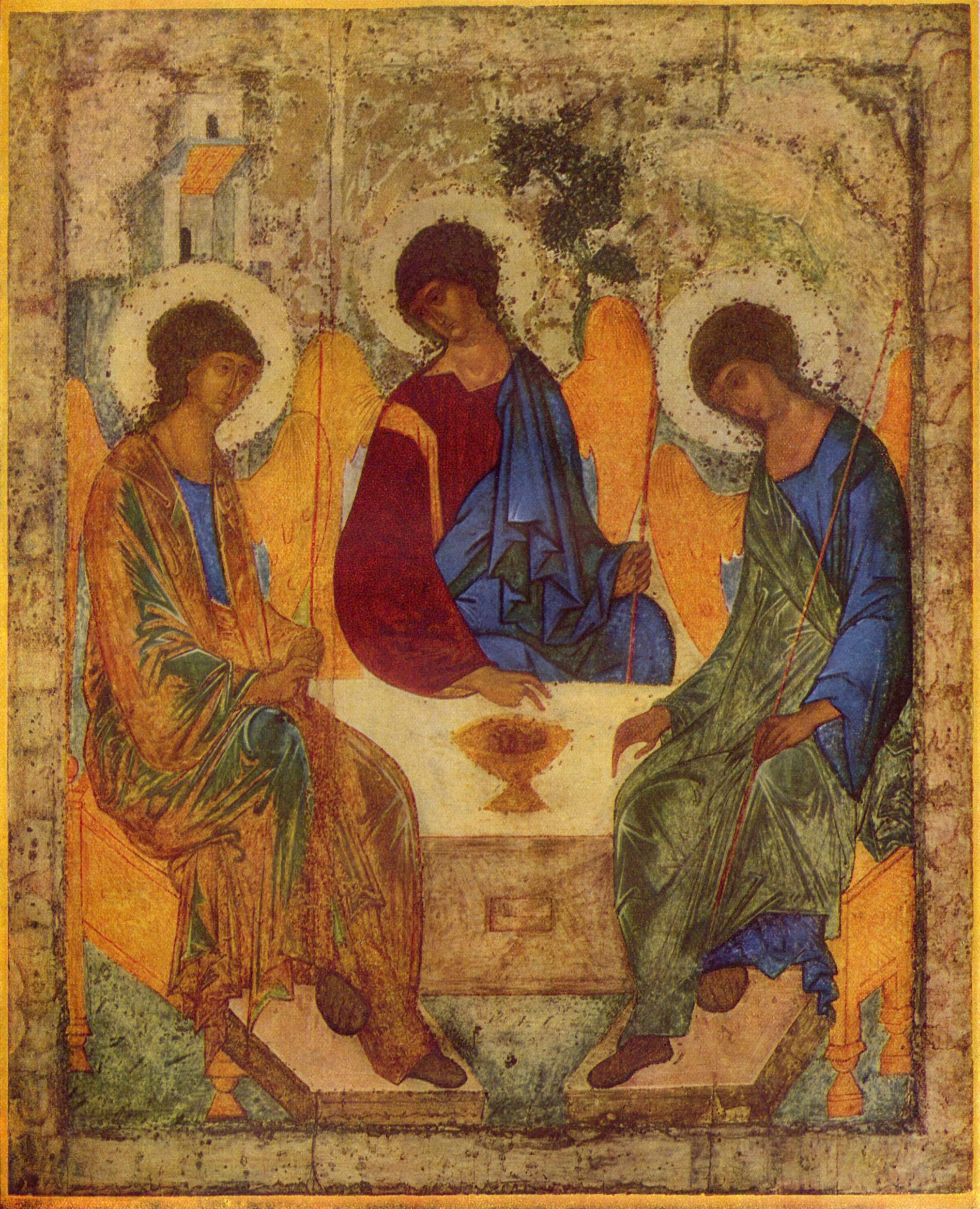
Milton's Multipartite God
 |
| Old Testament Trinity, by medieval Russian iconographer Andrey Rublev |
. . . But all ye gods,In "Milton’s Strange God: Theology and Narrative Form in Paradise Lost," Samuel Fallon notes that this idea of a bi- or tripartite God is in contrast with the prevalent Christian theology of Milton's time, which emphasized the Holy Trinity. Fallon remarks: "even at his most heretical, Milton could agree with nearly all Reformed thinkers when it came to God’s essential attributes," and stipulates various traits, including "oneness." Is this a valid assertion? Does Milton's portrayal of God really suggest a belief in the oneness of God? In what other ways are Milton's theological ideas less than orthodox or even "heretical"?
Adore him, who to compass all this dies,
Adore the Son, and honor him as me. (3:341-343)
Article Citation: Samuel Fallon. "Milton’s Strange God: Theology and Narrative Form in Paradise Lost." ELH 79.1 (2012): 33-57. Project MUSE. Web. 25 Sep. 2013.
Monday, September 23, 2013
A Paradise Lost by One

In the second book of Paradise Lost, Satan announces that he will "Through all the coasts of dark destruction seek / Deliverance for us all: . . . (2:464-465). The parallel to Christ's salvation here is, I think, more than apparent. Just as Christ is the author and finisher of our salvation--of our ascent back from a fallen condition--so also does Satan become the savior figure for those devils cast out of Heaven. But what really got to me was some lines that I came across among my annotations as I was reviewing the first book:
Millions of spirits for his [Satan's] fault amercedI had never really thought about this before, but just as man is saved by one supernal, vicarious act, so were those among that third part cast out for one singular act of selfishness. Each individual is, of course, responsible for his/her own actions and decisions, but would those "morning stars" and "sons of God" (Job 38:7) have relinquished their glory had not Lucifer stepped forward in defiance? After all, the Bible states that "all the sons of God shouted for joy" when the foundations of the earth were laid. Why then did they follow Lucifer, the light bringer that would cast them into darkness? What is the power of one to save or to damn?
Of Heav’n, and from eternal splendors flung
For his revolt . . . (1:609-611).
Monday, September 16, 2013
A Child is Born
So I decided to do my
sonnet on the passage, Isaiah 9:6-7
Isaiah 9:6-7 For unto us a child is born, unto us a son is given:
and the government shall be upon his shoulder: and his name shall be
called Wonderful, Counsellor, The mighty God, The everlasting Father, The
Prince of Peace.
7 Of the increase of his government and peace there shall be no end upon
the throne of David and upon his kingdom, to order it, and to establish it with
judgment and with justice from henceforth even for ever. The zeal of
the Lord of hosts will
perform this.
 |
| For Unto Us a Child is Born, by Simon Dewey |
And
here’s the sonnet.
A Child is Born
For
to us on this day, a child is born,
A
child so beautiful and full of grace.
He
is given to us, and he has sworn
To
save not just us, but the human race.
Wonderful,
Counselor, The Prince of Peace,
The
Endless Father, and The Mighty God.
We
shall call him these names and never cease,
To
worship the ground where he has yet trod.
On
his shoulders the government shall rest.
The
growth of his rule and peace shall not end,
For
the throne of David will be the best,
To
create the kingdom that we may tend.
The
judgment and justice of God above
Shall
come through this child with an endless love.
Subscribe to:
Posts (Atom)