Showing posts with label Adam and Eve. Show all posts

Friday, December 13, 2013

Man of Sin: Complete at Last!

Well, it's done! I'm finished with my paper, and I've submitted it to a couple of different venues. Here's the link for anyone interested in reading the full version.

https://drive.google.com/file/d/0B_oHVteZi_KNdkVsd0tndng1SUk/edit?usp=sharing

Saturday, November 16, 2013

Surprised by Fish

The Titans in Hell, by Gustave Doré
Public Domain
A while back, I wrote a quick post addressing some of Stanley Fish's broader claims in Surprised by Sin, quite possibly the most influential secondary resource for Milton's Paradise Lost. I've had a little bit of time to actually get into the text of late, so I have new discoveries and new contentions with some of the claims therein.

Overall, Fish makes some really intriguing points and corrects (perhaps too giddily) a number of flaws in theories then prevailing among Miltonic scholars. As a whole, though, I still wonder if Fish misinterprets the Satan character, despite his clear focus on his necessity in helping the reader to understand his own condition. I've been working to prove basically that same point but from the perspective that Milton's Satan figure should be interpreted not as the Biblical adversary but as one of many varying degrees of human depravity or fallenness. Fish certainly makes a number of claims that support this, but I feel like despite his insistence that Milton's objective is to "educate the reader to an awareness of his own condition," he is still fails to comprehend the Arch-fiend's existence as a degenerate condition of humanity.

Saturday, November 2, 2013

Two Falls, One Redemption: The Fates of Satan and Eve

Here is it! The paper! So much to explore, so few pages to explore it all in. I finish it late last night and decided to sleep on it and read it again in the morning to make sure it make some kind of sense. Here's hoping! It was extremely interested to consider the similarities and differences in the characterizations of Satan and Eve in Paradise Lost. I feel like I only had the opportunity to scratch the surface of the discussion and hope to delve further into some aspect of it for my final paper. Enjoy!

Tuesday, October 29, 2013

Pre-writing, Strength in Submission

I want to look at the perspective of Eve's nature through contrasting her decisions and fate with Satan's to show that Eve's weaknesses end up becoming her strengths, and without them, though the fall may not have happened, redemption would have not been possible without application of those same weaknesses.

Thesis:
While Eve's portrayal in Paradise Lost seems to set women as the weaker gender, the great irony of Milton's epic poem is that it ennobles weakness and degrades strength; Eve finds redemption in her “weakness”, while Satan remains fallen because of his “strength”.
  
Quotes:
“All is not lost; the unconquerable will, And study of revenge, immortal hate, And courage never to submit or yield: And what is else not to be overcome?”
Book 2 Lines 106-109

“O then at last relent: is there no place Left for repentance, none for pardon left? None left but by submission; and that word Disdain forbids me, and my dread of shame Among the spirits beneath, whom I seduced With other promises and other vaunts Than to submit, boasting I could subdue Th’ Omnipotent.”
Book 4: 78-88

“But what if God have seen, And death ensue? Then I shall be no more, And Adam wedded to another Eve, Shall live with her enjoying, I extinct; A death to think. Confirmed then I resolve; Adam shall share with me in bliss or woe: So dear I love him, that with him all deaths I could endure, without him live no life.”
Book 9: 826-833 (dependance on Adam)

Adam “And me with thee hath ruined, for with thee Certain my resolution is to die; How can I live without thee, how forgo Thy sweet converse and love so dearly joined, To live again in these wild woods forlorn?”
Book 9: 906-910


Basic outline:
  1. Introduction
  2. Characterizations
    A. Weakness of Eve
    B. Strength of Satan
  3. Two falls
    A. Eve's decisions
    B. Satan's decisions
  4. One Redemption
    A. Eve's dependence
    B. Satan's refusal to submit
  5. Conclusion

Sunday, October 27, 2013

Paradise Lost and the Fall: Men as Superiors

Keep reading, my post will deal with this eventually.
As a modern reader of Paradise Lost I am always tempted to look at Adam and Eve as equals and apply that belief to the story. But the fact of the matter is that Adam and Eve are never equals in this story. Adam is always superior. This should be unsurprising given the anti-feminist movement going on during Milton's day. He would have had easy access to the pamphlets circulating, as scholars such as Shannon Miller suggest. It's easy to read Milton's poem and think, "Yeah, here's another example of misogyny," yet the arguments between Adam and Eve in Book X of Milton's poem actually allows readers to consider the whole premise of the Fall. Women during Milton's day were looked at as seducers because of the interpretation of the creation myth, and so any arguments women made for themselves were looked at as seductive and not to be trusted. So when Adam blames Eve when God asks what's up, he has a perfectly valid excuse for blaming her: she was obviously up to no good. What's a man to do when she can't even open her mouth without trying to sway him from his will?

So how does this all tie in with my first idea, that Adam is always superior and never looks at Eve as an equal? Well, it has to do with the many Adam and Eve creation myths circulating out there.

Saturday, October 26, 2013

Pointing Fingers: "The Doctrine of Responsibility"

It shouldn't be surprising that there are times while reading Paradise Lost and while discussing the story of the Fall in general that I have been affronted/offended/indignant of the blame and inherent sin that is associated with Eve and the rest of the female sex. I don't think I have to label myself as a feminist to resent that smear for simply being born with the sensibilities of a woman.

So it wasn't Eve's fault that humanity fell?


Well, I don't think it is fair to put the entirety of the blame on Eve. When someone makes a big mistake what do we look at to figure out why? Their background, their understanding, their environment, their influences, and their relationships.

It was Adam's fault, then? 

Some see it that way. "Dennis Burden cogently argues that Milton would not allow so important an event as the fall to occur under circumstance arrived at only by chance...To exercise independent choice, says Burden, is a liberty improper to woman." He argues that it was actually Adam's fault that Eve ate the fruit because with his higher intellectual reasoning power should not have given into her passion and weaker intellect.
Frankly, I resent that argument, too.

Tuesday, October 22, 2013

Her the Inferior, Yet...

Yeah Milton, put Satanic Eve in her place.
    "Of Nature her the inferior, in the mind
    And inward faculties, which most excel;
    In outward also her resembling less
    His image who made both, and less expressing
    The character of that dominion given
    O'er other creatures:"

    Many female critics abhor this section of Paradise Lost where Adam is describing his reaction to Eve. Sandra M. Gilbert, speaking specifically of this attitude in Milton's work expressed,
     "for [Woolf], as for most other women writers, both [Milton] and the creatures of his imagination constitute the misogynistic essence of what Gertrude Stein called 'patriarchal poetry.'"
    While this reaction towards Milton is extraordinarily common among most critics, it is also helpful to realize where Milton is coming from. 64 years before the first publication of Paradise Lost, England mourned the loss of their Protestant, female ruler. The social and ideological implications of her rule on the English mind, more specifically on Milton's, raise so many questions. For example, did Milton view women as fit to rule on their own or did he see Elizabeth as a product of her male counselor? Did he sympathize with Elizabeth as a Protestant or was he a critic of her as a dictator?

    Hand in Hand, Yet Free

    This is likely going to be a quick post (though for some reason that never really works out). I just wanted to highlight a single line from Book IX of Paradise Lost, because I think it is one of the truest I've read about relationships and people to date. Adam and Eve are talking about whether they should split up so that they can get more done, and Adam is pretty opposed to it as a whole, but he says something that I think every husband and wife probably needs to learn to say and teaches us an important lesson about marriage:
    Go; for thy stay, not free, absents thee more (372)
    Adam pretty much called what was going to happen, and maybe we think he was a little bit unwise for not being more insistent with Eve, but I think he stumbled on a profound truth in realizing that were he to compel Eve or exercise any unrighteous dominion over her, it would compromise their relationship and make her more distant than if she were to simply go to a different part of the garden. Though a relationship has as its end goal the complete union of two beings, Adam recognizes that though a big part of that union is physical in nature, more important is their mutual respect and their willing heart--their unsolicited love.

    One of my dear friends, who is now close to seventy years old, said the most important thing that he learned in marriage was the phrase, "You're probably right." The reality is that throughout this earthly life, marriages are going to be full of conflicting opinions and differing ways of doing things, but in the end, it's not going to matter so much who was wrong or right about one matter or another. Rather, God will look upon us and see how we have chosen to grow together through kindness and longsuffering and patience and actively being peacemakers. And I think that in the end, despite the falls that we will have made (together), we'll be better off for it all...

    Eve and Delilah

              What is with these ladies?
              Really though...shall we take a look at Delilah's twisted logic?        
              We shall:

    The "Look, it was my fault for being weak..."
    "It was a weakness in me, but incident to all our sex, curiosity, inquisitive, importune of secrets, then with like infirmity to publish them, both common female faults:" (777)

    "But you probably should have expected that in the first place..."
    "Nor shoulds't thou have trusted that to woman's frailty:" (783)

    "I was just scared you would leave..."
    "I saw thee mutable of fancy, feared lest one day thou wouldst leave me." (794)

    "So your imprisonment is obviously ideal..."
    "Here I should still enjoy thee day and night mine and love's prisoner," (807)

    "Besides, I'm a hero! How cool is that?"
    "How honorable, how glorious to entrap a common enemy, who had destroyed such numbers of our nation." (857)

    "I mean, how could I say no?"
    "What had I to oppose against such powerful arguments?" (862)

              Delilah has--ONE--the gall to visit Samson while he's a prisoner--TWO--claim that it was her inherent weakness and ladyness that couldn't help but hurt him, and--THREE--take it all back once she realizes Samson is still doesn't want to be with her. Who can really blame him? Wasn't this at least offense number three or four against him?

    Sunday, October 20, 2013

    There may be such a thing as a stupid question...?

              This post is going to be kind of broken up and mostly filled with inquiries that I would love to be answered by you, my beloved classmates.

              First of all (again, all these might be pretty stupid questions) but at the beginning of every book of Paradise Lost, there's that little explanation that explains what that section is about, right? Why is the heading "The Argument" before every single one? 
              Second, Adam is given the commandment by God to "be fruitful, multiply, and fill the Earth." Buuuut I am confused because I thought that child-bearing was only possible after the fall...when they became mortal. So did God already anticipate the fall that early and kind of spoil the ending for readers?

    Tuesday, October 1, 2013

    Via Purifico

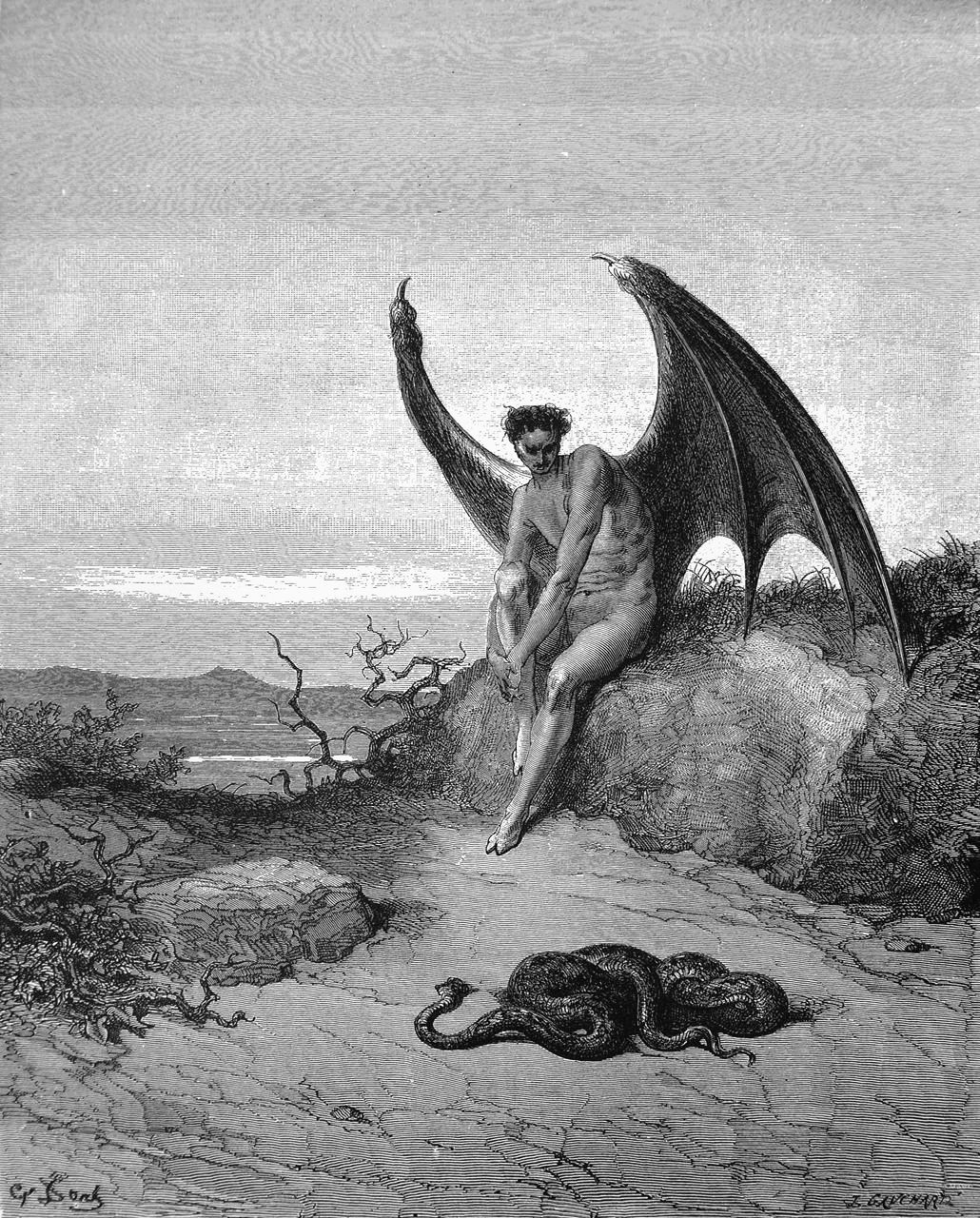
    Lucifer, the Fallen Angel
    by Gustave Doré
    My first post on this blog looks into the literature as a tool for better understanding the concept of loss and, by extension, redemption; also in a recent sonnet, I address more specifically the subject of Satan's redemption (or the impossibility of such), but in any case, this is a topic that I wanted to spiral back to in light of recent readings in Books V-VI and in various academic sources.

    IParadise Lost, Satan himself seems convinced that his damnation is final, the road to redemption being blocked not only by his own weakness but also by a spiteful god. In Book V, the apostate angel laments:
    But say I could repent and could obtain
    By act of grace my former state; how soon
    Would highth recall high thoughts, how soon unsay
    What feigned submission swore: ease would recant
    Vows made in pain, as violent and void.
    For never can true reconcilement grow
    Where wounds of deadly hate have pierced so deep:
    Which would but lead me to a worse relapse
    And heavier fall: . . . .(5:93-101)