Showing posts with label Stanley Fish. Show all posts

Saturday, November 23, 2013

Waving The Banner of Freedom For Personal Gain

Whew. Finally back into the swing of things. I've been really sick this week and am finally recovering so this is my attempt to begin catching up on my research work for my final paper.

In considering what to write my final paper on, I am drawn to a few ideas that have been floating around in my head for a while. I want to explore deeper the concepts from my last paper about freedom and submission (personified incorrectly by Satan and discovered by Eve). 

We live in a country founded on ideas drawn from Milton's of freedom and liberty from tyranny and many of the early founding fathers drew on these principles for their own writing and ideals. I feel that many have continued to hold on to the words of liberty but have lost the real meaning behind them or only used them as a face to help them find personal gain. Kind of like what Stanley Fish explains in his essay, "There Is No Such Thing As Free Speech"  In thinking about current situations and ideas, the words freedom and equality get thrown around recklessly and many seem to have a "down with the government I should get to do what I want cause I'm free" mentality. What are the consequences of seeking freedom through such means? I want to argue that this idea is what ruined Satan, and his actions and fate outline how this attitude actually destroys freedom. I don't want to focus so much on government, but the roles of citizens within the frame of government.

Is Freedom something achieved through government or is true freedom, freedom from government?
Basically there are two kinds of "freedom" one is negative and destructive and one provides progress and actual freedom for the individual. I found an awesome dissertation by following one of Professor Burton's ideas on his post that helped me discover the terms I was looked for to articulate the distinction.

Working thesis: Milton's On Tenure of Kings and Magistrates alongside his representation of Satan and Eve show the bounds in which freedom must be exercised to produce desired liberty. True freedom cannot be found without submission.

Still working to discover specifically what my conclusion is, but this is the frame work for my argument.


Tuesday, November 19, 2013

Man's Fallen Condition in Milton's Satan Figure: A Working Thesis

I just wanted to take a minute to post my working thesis for Paradise Lost and some recent reading from Stanley Fish's Surprised by Sin. I've posted my thesis previously as part of my first paper, and I've tackled Fish's work a couple of times already, but in any case, I want to spend more of my time tonight reading/researching rather than blogging, so this will likely be quick.

Working Thesis: In Paradise Lost, although Milton draws upon strong religious and archetypal currents in crafting his Satan figure, truly understanding his character (and thus, the epic as a whole) requires that the reader dissociate Satan's character from that of the Biblical adversary. Rather, Satan should be interpreted as a representation of the fallen condition of mankind and thus as a lens for better understanding the nature and degree of human fallenness.

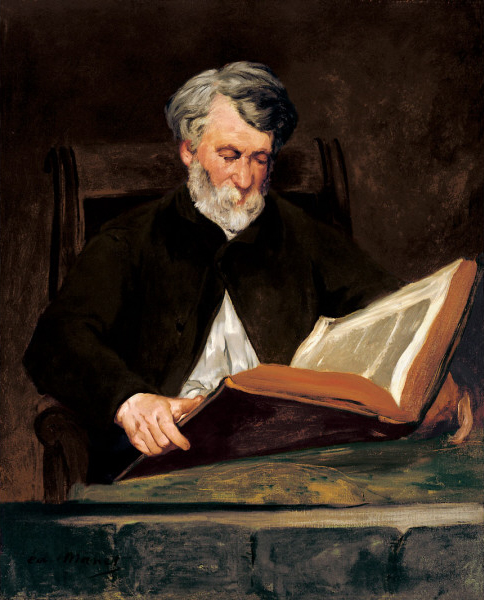
The Reader, by Edouard Manet
Wikimedia Commons
Today in Surprised by Sin, I finished off a big section on the reader's involvement in his own edification. Fish asserts that through Paradise Lost, the reader "becomes the detachedly involved observer of his own mental processes" and thus becomes an investigation of sin and fallenness within the reader himself (54). Fish suggests that Milton basically forces the reader to find the conflicts of Paradise Lost within himself and within his own psyche, and understanding the work requires that the reader acknowledge that the poem is essentially concerned with his salvation specifically. Fish notes, "The value of the experience depends on the reader's willingness to participate in it fully while at the same time standing apart from it" (43). He must see himself within the poem and yet see the poem as an independent entity. This is, in some ways, similar to my view that the reader must see himself in the Satan character (or vice versa) while still preserving the distance necessary to place him as a set character within a largely fixed narrative of the Edenic encounter.

Anyway, I'd love to hear your thoughts on my working thesis. Where are some areas where it's lacking, and does this contribute meaningfully to a study of Paradise Lost?
_________________________________________________________________________________
Fish, Stanley. Surprised by Sin: The Reader in Paradise Lost. 1967. Cambridge: Harvard U P, 1997. Print.

Friday, October 11, 2013

Though I Walk Through the Valley...

Adam and Eve Driven Out of Paradise, by John Martin (1824)
In Surprised by Sin, Stanley Fish proposes that Milton's narrative within Paradise Lost centers around the movement of the reader's consciousness rather than the movement of the plot itself. The story is not so much a story of Satan or God or even of Adam and Eve; rather, it is the story of the reader. It is the story of how how we came to our fallen condition, and at each turn, it invites us to look at the Fall from a different perspective: first from Satan's perspective, then from God's, then from Adam and Eve's, and so forth through a number of iterations. Thus, it invites the reader to examine his own 'fallen condition,' to come to terms with the reality that the hero of the epic--Satan--is really just another manifestation of man, in all his frailty. In short, by walking through hell and the fall, we come to understand what it means to be fallen and what brought us to such a state. It is revealing, then to realize, that Milton's Paradise Regained tells the story of Christ's victory over temptation in the wilderness. It would seem that Milton sees the Fall of man as being founded in ambition/pride and man's redemption, in the victory of Christ, independent of anything that we might do to try to merit salvation. I'll have to look more into Milton's views on salvation, but his denunciation of Antinomians in his political tracts seems to coincide with this idea of salvation by the grace of Christ alone.