Showing posts with label Surprised by Sin. Show all posts

Tuesday, November 19, 2013

Man's Fallen Condition in Milton's Satan Figure: A Working Thesis

I just wanted to take a minute to post my working thesis for Paradise Lost and some recent reading from Stanley Fish's Surprised by Sin. I've posted my thesis previously as part of my first paper, and I've tackled Fish's work a couple of times already, but in any case, I want to spend more of my time tonight reading/researching rather than blogging, so this will likely be quick.

Working Thesis: In Paradise Lost, although Milton draws upon strong religious and archetypal currents in crafting his Satan figure, truly understanding his character (and thus, the epic as a whole) requires that the reader dissociate Satan's character from that of the Biblical adversary. Rather, Satan should be interpreted as a representation of the fallen condition of mankind and thus as a lens for better understanding the nature and degree of human fallenness.
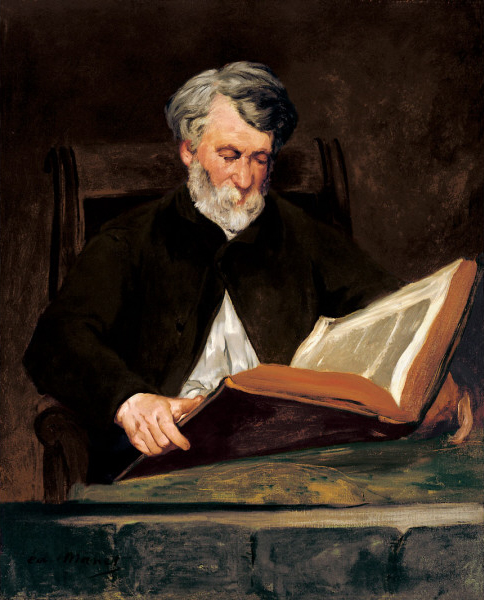
The Reader, by Edouard Manet
Wikimedia Commons
Today in Surprised by Sin, I finished off a big section on the reader's involvement in his own edification. Fish asserts that through Paradise Lost, the reader "becomes the detachedly involved observer of his own mental processes" and thus becomes an investigation of sin and fallenness within the reader himself (54). Fish suggests that Milton basically forces the reader to find the conflicts of Paradise Lost within himself and within his own psyche, and understanding the work requires that the reader acknowledge that the poem is essentially concerned with his salvation specifically. Fish notes, "The value of the experience depends on the reader's willingness to participate in it fully while at the same time standing apart from it" (43). He must see himself within the poem and yet see the poem as an independent entity. This is, in some ways, similar to my view that the reader must see himself in the Satan character (or vice versa) while still preserving the distance necessary to place him as a set character within a largely fixed narrative of the Edenic encounter.

Anyway, I'd love to hear your thoughts on my working thesis. Where are some areas where it's lacking, and does this contribute meaningfully to a study of Paradise Lost?
_________________________________________________________________________________
Fish, Stanley. Surprised by Sin: The Reader in Paradise Lost. 1967. Cambridge: Harvard U P, 1997. Print.

Saturday, November 16, 2013

Surprised by Fish

The Titans in Hell, by Gustave DorĂ©
Public Domain
A while back, I wrote a quick post addressing some of Stanley Fish's broader claims in Surprised by Sin, quite possibly the most influential secondary resource for Milton's Paradise Lost. I've had a little bit of time to actually get into the text of late, so I have new discoveries and new contentions with some of the claims therein.

Overall, Fish makes some really intriguing points and corrects (perhaps too giddily) a number of flaws in theories then prevailing among Miltonic scholars. As a whole, though, I still wonder if Fish misinterprets the Satan character, despite his clear focus on his necessity in helping the reader to understand his own condition. I've been working to prove basically that same point but from the perspective that Milton's Satan figure should be interpreted not as the Biblical adversary but as one of many varying degrees of human depravity or fallenness. Fish certainly makes a number of claims that support this, but I feel like despite his insistence that Milton's objective is to "educate the reader to an awareness of his own condition," he is still fails to comprehend the Arch-fiend's existence as a degenerate condition of humanity.

Friday, October 25, 2013

The Catalyst of Creation: Surprised by Saintliness

Stanley Fish would argue that as we read Paradise Lost, we feel for the character of Satan and that surprises us. To over-simplify his argument, we, as inherently good creatures, are surprised by what is deemed "other."

In Book VIII and IX of Paradise Lost, Adam and Eve have a similar experience as the reader. There is one specific time in which Adam's curiosity is aroused by the mysteries of God's creations and upon seeking explanation from Raphael is charged to
"Solicit not thy thoughts with matters hid;
Leave them to God above; him serve, and fear.
. . . Heaven is for thee too high
To know what passes there; be lowly wise:
Think only what concerns thee, and thy being;"
Adam is charged, not with sin, but with what could become sin. Eve, too, upon having the dream of eating the fruit has not sinned, but the seed of sin has been planted. Both husband and wife are surprised at this troubling event leading us to infer that they are, in fact, pure. Sin and the idea that it is within their capabilities is surprising and therefore "other."

The mysteries of God's creations also illicit surprise from quite another source. Here is Satan's reaction to God's crowning achievement, Eve:

Friday, October 11, 2013

Though I Walk Through the Valley...

Adam and Eve Driven Out of Paradise, by John Martin (1824)
In Surprised by Sin, Stanley Fish proposes that Milton's narrative within Paradise Lost centers around the movement of the reader's consciousness rather than the movement of the plot itself. The story is not so much a story of Satan or God or even of Adam and Eve; rather, it is the story of the reader. It is the story of how how we came to our fallen condition, and at each turn, it invites us to look at the Fall from a different perspective: first from Satan's perspective, then from God's, then from Adam and Eve's, and so forth through a number of iterations. Thus, it invites the reader to examine his own 'fallen condition,' to come to terms with the reality that the hero of the epic--Satan--is really just another manifestation of man, in all his frailty. In short, by walking through hell and the fall, we come to understand what it means to be fallen and what brought us to such a state. It is revealing, then to realize, that Milton's Paradise Regained tells the story of Christ's victory over temptation in the wilderness. It would seem that Milton sees the Fall of man as being founded in ambition/pride and man's redemption, in the victory of Christ, independent of anything that we might do to try to merit salvation. I'll have to look more into Milton's views on salvation, but his denunciation of Antinomians in his political tracts seems to coincide with this idea of salvation by the grace of Christ alone.