I just wanted to take a minute to post my working thesis for Paradise Lost and some recent reading from Stanley Fish's Surprised by Sin. I've posted my thesis previously as part of my first paper, and I've tackled Fish's work a couple of times already, but in any case, I want to spend more of my time tonight reading/researching rather than blogging, so this will likely be quick.
Working Thesis: In Paradise Lost, although Milton draws upon strong religious and archetypal currents in crafting his Satan figure, truly understanding his character (and thus, the epic as a whole) requires that the reader dissociate Satan's character from that of the Biblical adversary. Rather, Satan should be interpreted as a representation of the fallen condition of mankind and thus as a lens for better understanding the nature and degree of human fallenness.
Working Thesis: In Paradise Lost, although Milton draws upon strong religious and archetypal currents in crafting his Satan figure, truly understanding his character (and thus, the epic as a whole) requires that the reader dissociate Satan's character from that of the Biblical adversary. Rather, Satan should be interpreted as a representation of the fallen condition of mankind and thus as a lens for better understanding the nature and degree of human fallenness.
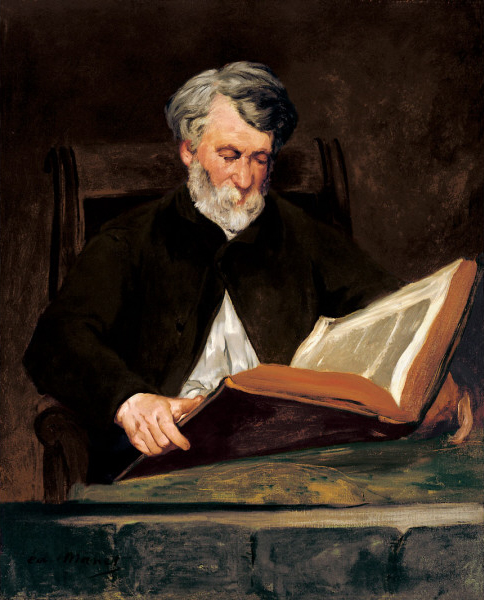 |
| The Reader, by Edouard Manet Wikimedia Commons |
Today in Surprised by Sin, I finished off a big section on the reader's involvement in his own edification. Fish asserts that through Paradise Lost, the reader "becomes the detachedly involved observer of his own mental processes" and thus becomes an investigation of sin and fallenness within the reader himself (54). Fish suggests that Milton basically forces the reader to find the conflicts of Paradise Lost within himself and within his own psyche, and understanding the work requires that the reader acknowledge that the poem is essentially concerned with his salvation specifically. Fish notes, "The value of the experience depends on the reader's willingness to participate in it fully while at the same time standing apart from it" (43). He must see himself within the poem and yet see the poem as an independent entity. This is, in some ways, similar to my view that the reader must see himself in the Satan character (or vice versa) while still preserving the distance necessary to place him as a set character within a largely fixed narrative of the Edenic encounter.
Anyway, I'd love to hear your thoughts on my working thesis. Where are some areas where it's lacking, and does this contribute meaningfully to a study of Paradise Lost?
_________________________________________________________________________________
Fish, Stanley. Surprised by Sin: The Reader in Paradise Lost. 1967. Cambridge: Harvard U P, 1997. Print.
.jpg)
