Showing posts with label paradise regained. Show all posts

Monday, December 16, 2013

Which key?: Unlocking Milton (social proof and scholarship)

I don’t think I have ever been more satisfied with a research paper in my whole career of paper writing! Maybe its because I had it almost entirely done a full day before it was due or because my ideas had had plenty of conversation and percolation. I actually managed to get to the point where I was in control of the paper rather than the paper in control of me.

The Milton controversy with Christianity and paganism was something we talked about from the beginning of the course. My blog posts pretty well document the progression of my idea itself (first here, then here and here). I initially thought I would focus on what kind of Christ Milton was depicting and why. But research, interviewing with Dr. Burton, and some of your suggestions led me more in the direction of why the use and then rejection of classical allusions and just letting the Christ and Christianity aspect work itself in.

The social proof aspect was what I think really made this project for me. Realizing that anyone could be a potential help, even if its just that I am able to reach a higher plane in talking with them made it exciting. I bounced ideas off of my husband, was super helpful in that regard. We so often assume people won’t be interested that we don’t say anything. (But really, we are writing the paper so that people will be interested, right? And if we hope to publish we need people to be interested.)
Another cool moment (that didn’t even hit me till right now) was actually in talking with my mother-in-law. In passing she asked what my paper was about, while I was working on it and I started to go through my thoughts. We had a nice little conversation about it, about Christ and classical learning, etc. What I had forgotten was that she was born and raised in the Catholic church before she became a member of the LDS faith and so had more of a background in to Milton’s world and what he was dealing with than I ever will. As it was, our brief talk helped me start to think more along the lines of what of Milton’s environment would have lead him to write what he did.

I started to get a little anxious-crazy when I realized I had a question and a good start on research but not really an answer. My vital claim was missing. Turning to the text in an in-depth effort to locate the bits and pieces I had been finding in my research cleared this up for me. The text sparked my question and after a look at what was going on, gaining an understanding of the pertinent background other than my own limited one, my answering could be found by returning to the text.

It’s like finding a lock and searching the whole house for the key. Once you’ve found a couple likely ones you can’t remember exactly what the lock looks like and so you have to take them all back to see which one fits.

Monday, November 25, 2013

Annotated Bibliography: Research Process

As I am researching more and more I’m beginning to think that maybe I’m not going deep enough. In addition to the thesis below I’ve been gathering information specifically regarding Milton’s deviation from traditional methods, and perchance utilizing these deviations to point out Christ’s superiority (meaning c. The thesis below is still bumbling but it isn’t as long. Is it too general? Too narrow? 

Working Thesis #2: Although Milton’s heavy use of classical pagan allusions can be a cause of confusion as far as his Christian directives, Milton is further defining his divine calling that they are a means to an end, that end being a personal understanding and relationship with Christ as the pinnacle of all learning. As demonstrated in Christ’s rebuttal of classical scholarship in “Paradise Regained."

Wednesday, November 13, 2013

The Power of the Feminine and the Power of the Moon: Eastern Thought in Eden

We've talked about the idea of passivity being the superior trait to dominance. This is a hard concept for our minds to grasp and is at the center of many gender debates right now. Passivity often characterized as a very feminine characteristics and is much less desirable than dominance. However, it seems like all the glorified characters in Paradise Lost and Paradise Regained are as dominant as they are evil. They dominate the books in regards to time and initiation of events. Satan is active. He makes stuff happen! He fights against God, he traverses Chaos. On the other hand, God and Christ are both very reactive and seem to have very little screen time. The GREATEST STORY OF ALL is Christ's reaction to Satan.

One thing that our culture does to throw a wrench in the works or make this seem contradictory is relate greatness to dominance. If, however, we read using the Eastern theories of power, things are easily reconcilable. Take, for example, some popular quotes from Taoist literature:
“The hard and mighty lie beneath the ground
While the tender and weak dance on the breeze above.”
― Lao Tzu
“The moon does not fight. It attacks no one. It does not worry. It does not try to crush others. It keeps to its course, but by its very nature, it gently influences. What other body could pull an entire ocean from shore to shore? The moon is faithful to its nature and its power is never diminished.”
― Deng Ming-Dao, Everyday Tao: Living with Balance and Harmony
Probably the most interesting reading I did this week was from the book The Chinese National Character: From Nationhood to Individuality. In it is addressed the idea that since WWII, American men have fought hard against the idea of relativism and passivity because they defined it as feminine. "In America, the immediate postwar era witnessed a censure of relativism, especially cultural relativism in anthropology, and the rise of a more affirmative attitude toward Western values vis-a-vis the totalitarianism of the Eastern Bloc." Other cultures, including the Chinese culture, do not see it that way. "Our Chinese colleagues objected strenuously whenever the word 'passivity' was used in connection with the Chinese preferences for a life of contemplation." In the eyes of the Chinese, it is the "passive" things (or "feminine" as defined by American ideals) that define success. For example, being well-read and scholarly is often in the form of memorizing poetry and learning languages. Good health is defined by eating light, not necessarily working out. Exercise is walking and badminton not lifting weight. In China, these are ideas of power. Perhaps reading Milton as a modern American inhibits our view of him and the real view of power. Power is less like dominion and more like vulnerability. It is the power to feel, the power to influence. It is the power of the feminine and the power of the moon.


Geography


While reading book four of Paradise Regained I was struck by the number of geographical references Milton inserts into his narrative. For example, lines 247-253 read:

"There flowrie hill Hymettus with the sound
Of Bees industrious murmur oft invites
To studious musing; there Ilissus rouls
His whispering stream; within the walls then view
The schools of antient Sages; his who bred
Great Alexander to subdue the world,
Lyceum there, and painted Stoa next:"

I think it's interesting that Milton uses such specific places in his text, and it leads me to assume that he was using what would have been common landmark references to paint a clearer picture of his Greek setting. Incidentally, I didn't recognize any of them, so I did a wee bit of research to more firmly grasp his meaning.

Ilissos circa 1900
The Ilissus, or Ilissos, is river which winds through and around Athens. Used for a defensive perimeter and named after a demigod of the same name, the cannaled waterway was viewed as a peaceful, idyllic setting.

Hymettus is, contrary to Milton's description of a "hill," a mountain range also located in Athens. Also called "Trellos," or "crazy mountain," by its inhabitants, the peaks have been home to marble quarries for thousands of years.

While a lyceum is an educational institution still used in many European countries, the Lyceum proper was a gymnasium and public meeting place in, once again, Athens. Built in a grove of trees, the edifice is most commonly associated with Aristotle's peripatetic school, though it was in existence prior to his endeavors. 

Along with his other references, Milton spends quite a lot of time building up the setting for this section, a move which lends the reader a clearer picture of what he or she is reading as well as stronger ties to the Athenian culture and landscape. I'm curious as to where this pattern pops up in his other works, and how his time in the country aided his descriptive powers.


Tuesday, November 12, 2013

To Taste Despair: Satan's Capacity for Sorrow in Paradise Regained

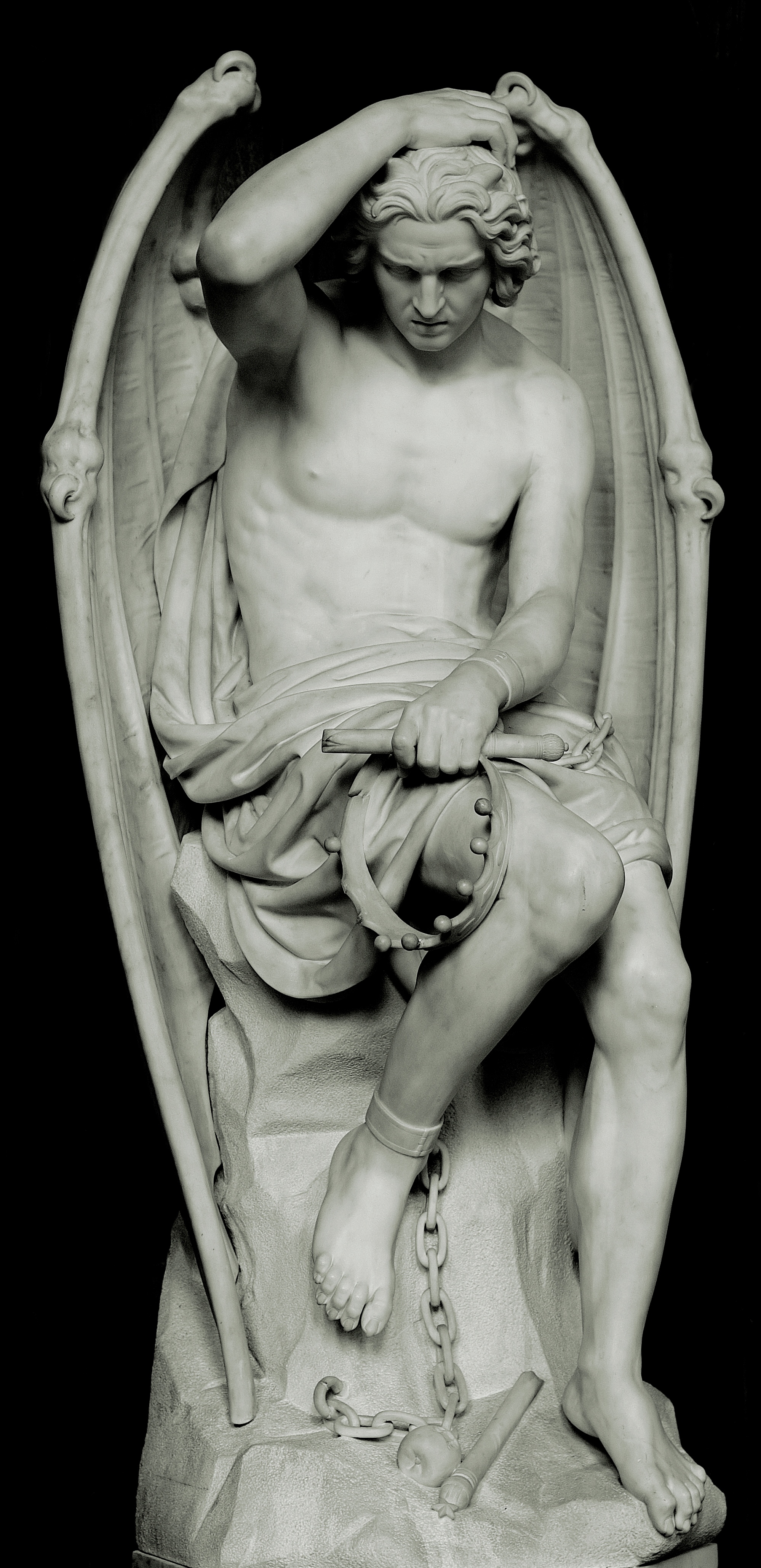
Le Génie du Mal (1848)
One of the topics that I've been looking into as I've compiled my resources for my research paper on the Satan figure in Paradise Lost is his capacity for despair and doubt. Within Paradise Lost itself, there are numerous occasions where it seems almost as though Milton sympathizes with Satan, recognizing his pain and presenting it as masked human emotions. As early as book 1, for example, Milton writes, "So spake th’ apostate angel, though in pain, / Vaunting aloud, but racked with deep despair" (I:125-126, emphasis mine). Milton emphasizes the inner pain and discouragement that Satan experiences, painting in a way that makes him seem almost human--saying one thing but feeling another, putting on a brave face while cowering within.

As one might perhaps expect, this idea of despair carries over into Paradise Regained as well. I was struck by a particular passage in Book III, where Milton described the tempter as "inly racked" (203). Satan remarks, "[A]ll hope is lost / of my reception into grace; what worse? (204-205). This again shows the conflict between Satan's emotions and his words, though in this instance, the reader understands a bit better the emptiness in his words; we realize that those same words which he's speaking are the words that rack his soul and conscience. The verb "to hope" in Latin is spero, and so de-spair then becomes a state wherein one is deprived of hope. This mirrors the words of Milton's adversary, who says "all hope is lost." He recognizes to some extent the futility of his own struggle, realizing that whether or not Christ reigns, Satan himself is still damned and that success will not bring him out of his despicable state.

Monday, November 11, 2013

Milton: Classical Philosophers vs. Christ...or Lacking an angle

Shorter post, I am still trying to pick a research topic. Slow I know, but I also know the consequences of picking a hasty, malformed one and that is positively torture!

One thing I've really been interested in the whole time is Milton's classical allusions. I might be more excited about them because I've recently taken a class where we have read from a lot of what Milton references so I actually get some of the allusions!

That is where I've gotten a wee bit stuck because what do I argue beyond the obvious? Yep, Milton uses classical allusions. A lot. In nearly every single one of his works. Huge, broad, ugly paper.
But then, I finished reading Paradise Regained and this passage through me for a loop.

[Satan long blurb going on and on about ancient and classical philosophers...]

To whom our Savior sagely thus replied.
"Think not but that I know these things, or think
I know them not; not therefore am I short
Of knowing what I ought: he who receives
Light from above, from the fountain of light,
No other doctrine needs, though granted true;
But these are false, or little else but dreams,
Conjectures, fancies, built on nothing firm.
The first and wisest of them all professed
To know this only, that he nothing knew;
the next to fabling fell and smooth conceits,
A third sort doubted all things, though plain sense...
For all his tedious talk is but vain boast, 
Or subtle shifts conviction to evade.
Alas what can they teach, and not mislead;
Ignorant of themselves, of God much more,
And how the world began, and how man fell
Degraded by himself, on grace depending?"
(IV.287-296, 307-312)

(it goes on for a bit more along the same vein.)
Within the context of the Christ and Satan discussion this makes some sort of sense to me. But when you think about Milton saying it, what does that mean? If there is anyone who loves classical philosophers and connections it is Milton. To say these are "false or little else but dreams" seems to be cutting down/undermining all that Milton has previously written about.
Still working on it...any thoughts?

Paradise Regained

          Not sure if I'm going to be in class today, but I'll be honest...I did not really enjoy Paradise Regained. I don't even really know why because it was just as beautifully written and all... I don't know.
          Anyways, here's what I found amusing was for almost the whole four books, Satan and Christ are arguing back and forth, and this is how their replies are described:

Satan: uttered / answered malcontent / accosts / murmuring thus replied / inly racked replied / impudent replied / with fear abashed replied / with stern brow replied / swoll'n with rage replied

Christ: with unaltered brow / temperately replied / patiently replied / calmly thus replied / fervently replied / answered thus unmoved / sagely thus replied / answered with disdain (finally when Satan starts getting really really annoying and talks bad about God.)

          Christ is just so patient through it all because he knows he's got nothing to worry about--he's not in the wrong, not like Satan is, who is obviously getting flustered about failing to sway Christ.

Humility and "Active Passivity" in Paradise Regained

I had a couple of thoughts as I finished Paradise Regained.  One is concerning the ending.  The final image that Milton chooses to leave us with is of Christ, having just defeated Satan in his temptations, simply returning home.  Milton writes, "Thus they the Son of God our Savior meek / Sung victor, and from Heav’nly feast refreshed / Brought on his way with joy; he unobserved / Home to his mother’s house private returned" (Book IV, ll. 636-639).  It's such a small image to end the story on, especially considering the context.  Jesus has just had his first victory over Satan, he has just partaken of a heavenly feast, and a chorus of angels have just told him "thou hast avenged / Supplanted Adam, and by vanquishing / Temptation, hast regained lost Paradise" and "thy glorious work / Now enter, and begin to save mankind" (Book IV, ll. 606-608, 634-635).  The ending does a couple of things for me:  One is that it again reinforces Christ's humility.  After such a triumph and a praising by the angels of heaven, Christ doesn't have a huge celebration to brag about himself to all of the world, but instead simply returns home to his mother, who has no doubt been worrying about him.  

Wednesday, November 6, 2013

Christ and the Temptation

Today's class discussion had me considering a question that was asked:  Why did Milton choose the action for this sequel called Paradise Regained to be something that at first glance seems relatively minor?  Why not make Paradise Regained the story of the Second Coming, or of the Crucifixion, or of the Resurrection?  Why follow up such a grand epic like Paradise Lost, with such a small epic (while still giving it such a monumental sounding name like Paradise Regained)?

Looking at the text and considering a few things from Christian teachings, I believe that there are a couple of reasons for this.  One reason for Milton choosing to tell this story of the temptations of Christ to explain how paradise was/is regained is the fact that this story immediately follows Jesus' confirmation by the Holy Spirit of God that he is the Son of God, thus making all his actions in that moment the first true test of his divinity.  


Christ’s Awakening To Divinity

 I’ve always found it interesting to think about what Christ thought of himself as he grew up. To what extent was he aware of his divinely appointed mission? What did he know about his heritage and what did he not know? How did he feel as a youth growing up, did he feel more mature, different than everyone around him? So many interested questions that we have little to no knowledge about from Biblical Accounts. We have accounts of Apostles writing about the divinity of Christ but nothing written by Christ himself about his life or mission. In our own Mormon literature, Jesus the Christ offers some insight into some of these possibilities but beyond that we don’t have much.

The first chapter Paradise Regained offers an interesting perspective on some of these questions in a narrative written from the perspective of Christ. I think Milton did a fantastic job at diving into these questions and creating a persona that I could see as a very possible reality for what the young Jesus may have thought.

Friday, October 11, 2013

Though I Walk Through the Valley...

Adam and Eve Driven Out of Paradise, by John Martin (1824)
In Surprised by Sin, Stanley Fish proposes that Milton's narrative within Paradise Lost centers around the movement of the reader's consciousness rather than the movement of the plot itself. The story is not so much a story of Satan or God or even of Adam and Eve; rather, it is the story of the reader. It is the story of how how we came to our fallen condition, and at each turn, it invites us to look at the Fall from a different perspective: first from Satan's perspective, then from God's, then from Adam and Eve's, and so forth through a number of iterations. Thus, it invites the reader to examine his own 'fallen condition,' to come to terms with the reality that the hero of the epic--Satan--is really just another manifestation of man, in all his frailty. In short, by walking through hell and the fall, we come to understand what it means to be fallen and what brought us to such a state. It is revealing, then to realize, that Milton's Paradise Regained tells the story of Christ's victory over temptation in the wilderness. It would seem that Milton sees the Fall of man as being founded in ambition/pride and man's redemption, in the victory of Christ, independent of anything that we might do to try to merit salvation. I'll have to look more into Milton's views on salvation, but his denunciation of Antinomians in his political tracts seems to coincide with this idea of salvation by the grace of Christ alone.

Saturday, September 7, 2013

Introductions, and Literature of Loss


Well, hello there, everyone. My name's Greg Bayles, and in case there was any doubt in your mind, the bespectacled fellow to the left is, in fact, me. I'm from Las Vegas, NV, and I'm a senior (yikes!) studying English. I love reading and writing, and I have aspirations to write novels (though during school, I mostly write poetry because of time constraints). Among other hobbies are pretty much all water sports, swimming being the most prominent of these; playing and composing on the piano; riding my bike at night; and making new friends. I'm also an unabashed Slavophile, and I speak Russian fluently. Generally, I like to think that I'm a fairly easy-going guy most of the time, though that's probably a common sentiment among the up-tight and crotchety as well. In any case, I'm excited to get to work with everyone, and I'm really glad for the chance to dive into Milton.