Showing posts with label Milton. Show all posts
Showing posts with label Milton. Show all posts
Tuesday, December 17, 2013

Monday, December 16, 2013
Looking Back and Moving Forward
 Well, as the semester comes to a close, I wanted to talk a little bit about my research process for the paper that I finished last week on the humanity of John Milton's Satan figure in Paradise Lost. They say that sometimes looking back on where you've been can be one of the most important things in helping you to move forward, and Heaven knows well enough that with graduation soon approaching, I could use some perspective.
All in the all, I really enjoyed researching the topic. It's one of the most fundamental concepts in understanding Paradise Lost, and I felt like there was a little place cut out for me in terms of being able to contribute to the overall conversation. My research really began with Stanley Fish's Surprised by Sin, one of the most influential works of criticism for PL. I started reading it about a month into the semester and got through most of it by the time that I needed to start actually drafting, so it was really influential in terms of helping me to form my research question. I build my question around a question that I felt Fish had neglected to some extent, that Satan can in some sense be seen as a regular human character with regular human vices. As a result, my paper was largely a response to his criticism. I got some really valuable feedback along the way, though, and that really helped to shape my research.
Sunday, December 15, 2013
On the Creation of Modern Comparison
 |
| Except this is really my last one of my undergraduate career. Still, it feels never-ending. Probably will be. |
There were only a few times that I found myself interested in Milton's work. Those times were his Divorce Tracts and Areopagitica. That's not to say that I didn't find class discussions and the primary texts interesting. I just mean to say that Milton didn't astound me with his poetry the way that Eliot does. I don't like very much poetry, so I will always be more fond of prose.
Friday, December 13, 2013
Thursday, December 12, 2013
A Message to Today: Why Milton Matters in Relation to the Edward Snowden Leaks
Here is the link to my final paper.
Wednesday, December 11, 2013
Final Milton Paper
First! Good luck with finals everyone!
The Dangers of Extreme Individualism in the Pursuit of Freedom
The Dangers of Extreme Individualism in the Pursuit of Freedom
Wednesday, December 4, 2013
Publication/Presentation Venues for John Milton
I've been looking into various presentation venues for my research on John Milton's Satan figure, and I've found a few outlets that look like they could be really positive:
Milton Society of America General Session on John Milton — MLA Conference 2014
British Society for Literature and Science Conference — April 10-12, 2014
This conference, held at the University of Surrey, accepts papers addressing all aspects of literature and science, and while it's kind of a vague outlet for my research, it still might be a good venue. It looks like it has accepted a number of papers on Milton in the past, so my hope would be that it would this time as well. The only problem is that the submission deadline is this Friday, the 6th, so I would need to get a proposal together by then. Not sure whether that will be possible, what with research papers and everything else going on.
Milton Society of America General Session on John Milton — MLA Conference 2014
This is an open call for papers on all topics pertaining to John Milton. They are looking for papers of eight-page or twenty-minutes, which is a tad bit short of what we're working toward, but I could definitely shorten it down for the submission. Papers are due by March 15, 2013.
Fall Stories Conference — 18th-19th June 2014
This conference, hosted at the University of Aberdeen in Scotland, addresses the Fall from an interdisciplinary perspective and invites submissions from a broad range of disciplines. The location will likely preclude my personal participation, but they might be willing to facilitate a digital presentation. I still hope to submit in any case. The submission deadline is listed as March 31, 2013, but I'm checking to see if the year is a typo.
Fall Stories Conference — 18th-19th June 2014
This conference, hosted at the University of Aberdeen in Scotland, addresses the Fall from an interdisciplinary perspective and invites submissions from a broad range of disciplines. The location will likely preclude my personal participation, but they might be willing to facilitate a digital presentation. I still hope to submit in any case. The submission deadline is listed as March 31, 2013, but I'm checking to see if the year is a typo.
British Society for Literature and Science Conference — April 10-12, 2014
This conference, held at the University of Surrey, accepts papers addressing all aspects of literature and science, and while it's kind of a vague outlet for my research, it still might be a good venue. It looks like it has accepted a number of papers on Milton in the past, so my hope would be that it would this time as well. The only problem is that the submission deadline is this Friday, the 6th, so I would need to get a proposal together by then. Not sure whether that will be possible, what with research papers and everything else going on.
**UPDATE** 12/6/2013
I just submitted my project proposal for the BSLS Conference. It was kind of rushed because of time constraints, but in any case, here it is:
It has often been argued among Miltonic scholars that Paradise Lost's Satan figure represents the most dynamic character in the epic and in some sense thus fills the role of the “hero.” A great deal of debate has, of course, erupted over the notion of the Judeo-Christian devil as a hero, a complex, contemplative character deserving at times the reader's sympathy. And if, as some have suggested, Milton's Satan is just Satan—simply a reinterpretation of and creative expansion upon the Biblical or archetypal figure—then certainly Milton has done the reader a great disservice in spending nigh on one third of the epic investigating a fiendish brute from whom man can learn nothing. The reality is, however, that Satan's complexity and dynamicity lend to his character a degree of humanity that ultimately allows the reader to see his own condition within Satan's experiences—struggles which in many ways parallel and build upon the struggles of Adam and Eve following their expulsion from Eden. In this paper, I argue for the 'humanity' of Milton's Satan figure. Although Milton draws upon strong religious and archetypal currents in crafting his Satan figure in Paradise Lost, truly understanding the arch-fiend's character (and thus, the epic as a whole) requires that the reader decouple Satan's character from that of the archetypal Biblical adversary and view him instead as a representation of one of the graduated stages of mankind's fallen condition.
There were a bunch whose deadlines had already passed, but otherwise, that's all that I've found for now. Hopefully the weekend will provide me with some more time to look into this more.
Tuesday, December 3, 2013
Social Interaction

I got around to emailing two people, Dr. Vincent Blasi, a professor of Law at Columbia who wrote an article on Milton and the First Amendment. He hasn't emailed me back yet (and I'm really not sure he will), but this is the email I sent:
Monday, November 25, 2013
Milton, Satan, and Religious Tyranny: Annotated Bibliography
Alright so here's my revised working thesis. "Milton channels his own views and personality into Satan in order to create a more human version of the devil as opposed to the previous versions of the devil in Christian literature. Milton creates this new form of Satan in order to make a political statement against the tyranny of the monarchy in the Church." I'm still working on what exactly Milton is fighting against in the Church.
More Annotated Sources
 |
| John Milton, Monalisa 2013 |
ANNOTATED BIBLIOGRAPHY.2
First, let's cover some social media.
Gabriel Jbreel Hess
- An aspiring military chaplain, he posts numerous links to Edward Snowden's leaks and articles about the NSA.
- I've already talked to him, and he's been willing to help me find more things as they pop up.
Google+ Media
- Communities are few and far between that deal strictly with the NSA and Edward Snowden, but all you have to do is type in #NSA or #Snowden on the search bar and you come up with this.
- This is an invaluable source for breaking news information I could use to further my argument.
- Typing in #Milton or #JohnMilton lends very few results.
Saturday, November 23, 2013
Waving The Banner of Freedom For Personal Gain
Whew. Finally back into the swing of things. I've been really sick this week and am finally recovering so this is my attempt to begin catching up on my research work for my final paper.
In considering what to write my final paper on, I am drawn to a few ideas that have been floating around in my head for a while. I want
to explore deeper the concepts from my last paper about freedom and
submission (personified incorrectly by Satan and discovered by Eve).
We live in a country founded on ideas drawn from Milton's of freedom and liberty from tyranny and many of the early founding fathers drew on these principles for their own writing and ideals. I feel that many have continued to hold on to the words of liberty but have lost the real meaning behind them or only used them as a face to help them find personal gain. Kind of like what Stanley Fish explains in his essay, "There Is No Such Thing As Free Speech" In thinking about current
situations and ideas, the words freedom and equality get thrown
around recklessly and many seem to have a "down with the government I should get to do what I want cause I'm free" mentality. What are the consequences of seeking freedom through such means? I want to argue that this idea is what ruined Satan, and his actions and fate outline how this attitude actually destroys freedom. I don't want to focus so much on government, but the roles of
citizens within the frame of government.
Is Freedom something achieved through
government or is true freedom, freedom from government?
Basically there are two kinds of "freedom" one is negative and destructive and one provides progress and actual freedom for the individual. I found an awesome dissertation by following one of Professor Burton's ideas on his post that helped me discover the terms I was looked for to articulate the distinction.
Working thesis: Milton's On Tenure
of Kings and Magistrates alongside
his representation of Satan and Eve show the bounds in which freedom
must be exercised to produce desired liberty. True freedom cannot be
found without submission.
Still working to discover specifically what my conclusion is, but this is the frame work for my argument.
Friday, November 22, 2013
Media Resources on Satan's Humanity in Paradise Lost
I've been doing some alternative media and social searches for my research on Milton's Satan figure in Paradise Lost, and it's been interesting to hear peoples' perspectives. I keep wondering whether some honor code officer is going to come over and arrest me for doing queries for videos about the humanity of Satan, but so far, things have gone smoothly. I've come across a fair number of resources relating to my topic and have only had to wade through a few Satanist videos and a wealth of screamo/hard rock music based on Milton's Satan figure. I guess in some way, that's art, too, so I should probably care more about it...
In any case, I wanted to share some of the preliminary materials that I've found. I posted a while ago about the Paradise Lost video game, and I'm also a big fan of Eric Whiatacre's Paradise Lost music. This video won't embed for some reason, but it's an original composition that a student wrote as a part of his study of Paradise Lost in a humanities class. The description notes, "Through John Milton's eyes, Lucifer is a sympathetic and human like character, not the evil corrupted figure we usually see when we think of Lucifer." This is a fairly simple piece of commentary, but it nonetheless shows that he is seriously engaging this idea of Satan's humanity. I don't know that he would be a phenomenal resource, but it's certainly neat to see how an interest in Paradise Lost can lead to other creative efforts.
In any case, I wanted to share some of the preliminary materials that I've found. I posted a while ago about the Paradise Lost video game, and I'm also a big fan of Eric Whiatacre's Paradise Lost music. This video won't embed for some reason, but it's an original composition that a student wrote as a part of his study of Paradise Lost in a humanities class. The description notes, "Through John Milton's eyes, Lucifer is a sympathetic and human like character, not the evil corrupted figure we usually see when we think of Lucifer." This is a fairly simple piece of commentary, but it nonetheless shows that he is seriously engaging this idea of Satan's humanity. I don't know that he would be a phenomenal resource, but it's certainly neat to see how an interest in Paradise Lost can lead to other creative efforts.
Wednesday, November 20, 2013
Researching Conventional Literary Scholarship: 12 Ways
While I have urged my students to diversify their literary research by adding a social and new media layer to their inquiry process, I also want them to make good use of available, conventional scholarship. Here are several good ways to do this. Rather than introducing just a set of specific databases or sites, I wish to emphasize principles of good research in the digital age.
Here are 12 ways to go about researching conventional literary scholarship
Here are 12 ways to go about researching conventional literary scholarship
Research Proposal: Looking at Milton and Satan Through Political Lens
 So I've refined my thesis a bit: "Milton channels his own views and personality into Satan in order to create a more human version of the devil as opposed to the previous versions of the devil in christian literature. Milton creates this new form of Satan in order to make a political statement on the monarchy in the Church."
I'll tweak it more as I do some more research but that's the basic idea. As for research, I need to look up other versions of the devil in Christian literature to compare to Milton's Satan. I could probably use the devil from Doctor Faustus. I could probably even use the Bible for that as well. I also need to do research on some of the political issues Milton was fighting against during the time he was writing Paradise Lost, particularly on his feelings on the politics in the Church. If you guys happen to find anything related to that, let me know.
Tuesday, November 19, 2013
Man's Fallen Condition in Milton's Satan Figure: A Working Thesis
I just wanted to take a minute to post my working thesis for Paradise Lost and some recent reading from Stanley Fish's Surprised by Sin. I've posted my thesis previously as part of my first paper, and I've tackled Fish's work a couple of times already, but in any case, I want to spend more of my time tonight reading/researching rather than blogging, so this will likely be quick.
Working Thesis: In Paradise Lost, although Milton draws upon strong religious and archetypal currents in crafting his Satan figure, truly understanding his character (and thus, the epic as a whole) requires that the reader dissociate Satan's character from that of the Biblical adversary. Rather, Satan should be interpreted as a representation of the fallen condition of mankind and thus as a lens for better understanding the nature and degree of human fallenness.
Working Thesis: In Paradise Lost, although Milton draws upon strong religious and archetypal currents in crafting his Satan figure, truly understanding his character (and thus, the epic as a whole) requires that the reader dissociate Satan's character from that of the Biblical adversary. Rather, Satan should be interpreted as a representation of the fallen condition of mankind and thus as a lens for better understanding the nature and degree of human fallenness.
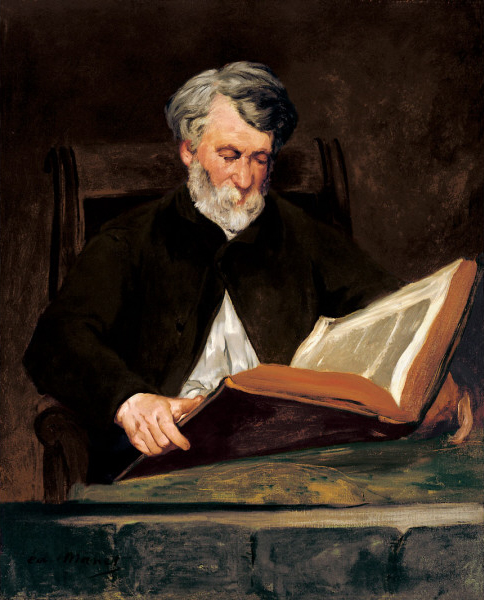 |
| The Reader, by Edouard Manet Wikimedia Commons |
Today in Surprised by Sin, I finished off a big section on the reader's involvement in his own edification. Fish asserts that through Paradise Lost, the reader "becomes the detachedly involved observer of his own mental processes" and thus becomes an investigation of sin and fallenness within the reader himself (54). Fish suggests that Milton basically forces the reader to find the conflicts of Paradise Lost within himself and within his own psyche, and understanding the work requires that the reader acknowledge that the poem is essentially concerned with his salvation specifically. Fish notes, "The value of the experience depends on the reader's willingness to participate in it fully while at the same time standing apart from it" (43). He must see himself within the poem and yet see the poem as an independent entity. This is, in some ways, similar to my view that the reader must see himself in the Satan character (or vice versa) while still preserving the distance necessary to place him as a set character within a largely fixed narrative of the Edenic encounter.
Anyway, I'd love to hear your thoughts on my working thesis. Where are some areas where it's lacking, and does this contribute meaningfully to a study of Paradise Lost?
_________________________________________________________________________________
Fish, Stanley. Surprised by Sin: The Reader in Paradise Lost. 1967. Cambridge: Harvard U P, 1997. Print.Hunger and Consequences
So after much consideration and probably not quite enough research I've narrowed my original topic down quite a bit:
Thesis: In Paradise Lost and Paradise Regained Milton uses hunger, both physical and metaphorical, as the defining tool for character development in Satan and Christ respectively, ultimately illustrating the author's point that it is not circumstance which defines the individual, but how that individual chooses to act.
I'm still banging out a few obvious flaws, but I've ditched Adam and Eve to focus on Satan and Christ. I think this has the potential to shed some light on the dichotomy between these two principle characters, and I'm thinking I'll pull in some of Milton's other works where he characterizes them to draw parallels. I'm also still considering bringing in other figures in Milton's work who suffer from hunger.
Unfortunately I haven't quite figured out how to work actual food in. But the night is young, I may find a way yet.
 |
| And, since this is a really short post, here's how I feel about the autumn season. |
Thesis: In Paradise Lost and Paradise Regained Milton uses hunger, both physical and metaphorical, as the defining tool for character development in Satan and Christ respectively, ultimately illustrating the author's point that it is not circumstance which defines the individual, but how that individual chooses to act.
I'm still banging out a few obvious flaws, but I've ditched Adam and Eve to focus on Satan and Christ. I think this has the potential to shed some light on the dichotomy between these two principle characters, and I'm thinking I'll pull in some of Milton's other works where he characterizes them to draw parallels. I'm also still considering bringing in other figures in Milton's work who suffer from hunger.
Unfortunately I haven't quite figured out how to work actual food in. But the night is young, I may find a way yet.
Monday, November 18, 2013
Areopagitica and the People’s Rights to Information and Government Transparency

Thesis/Opening Paragraph:
Milton’s political tracts boldly
declare his belief that in order for the people to be a functioning,
self-governing body, they had to have the right to uncensored information. This
belief, completely rejected by Parliament, would come up later in American
government with the creation of the First Amendment. Yet in America today,
we’re struggling with the same problems Milton faced in his time. How do we, as
a people, make informed decisions about our government if we don’t have the
freedom of information? Is it possible to strike a balance between a
transparent government and free flow of information and government secrets and
operatives’ safety? Like Milton, we have several figures in the world that are willing to risk their lives for their belief that the
uncensored exchange of ideas and information is tantamount for the people to
avoid corrupt government, oppression, and social injustice. While many names
come to mind, I would like to focus on two main figures in this regard:
WikiLeaks founder Julian Assange and NSA whistleblower Edward Snowden. Both
Assange and Snowden believe that the only way to truly make change for the
better is to let people see what’s really going on in all sectors of government
and economics. Milton’s premise of freedom of information in Areopagitica completely supports this
view.
Wednesday, November 13, 2013
A short post
I'm sorry this post won't be very long. I'm working on narrowing down my topic so that I can make an actual good thesis. I'm interested in the topic of overreachers, both contextually in the works of Milton and intertextually in the works of those that he was influenced by and those that he later influenced. Obviously I don't just want to list examples of overreachers throughout literature, so I'm working on narrowing it to an actual defensible argument. One thing that intrigues me that I've been trying to look at is the idea of Milton himself as a kind of overreacher. We've said many times in class that Milton was marked by strong ambition--even sense of destiny--that he had to do something great in his life. We see examples of this in his writing, most notably in the opening lines of Paradise Lost where he states that he is trying to write a poem "That with no middle flight intends to soar / Above th’ Aonian mount, while it pursues / Things unattempted yet in prose or rhyme" (I: 14-16). Milton had to be aware of his own ambition, seeing as how it is a common theme throughout both Paradise Lost and Paradise Regained. In PL we see untempered ambition personified in the form of Satan who attempts to usurp the throne of God and fails miserably; while in PR we see the dichotomy of ambition in Christ, someone who is ambitious but who tempers that ambition with patience in waiting on God the Father for instruction. Which one would Milton have thought of himself as being more like? Likely, Milton wished he was more like Christ (obviously), while knowing that he was closer to Satan in terms of his level of ambition. After all, Milton spent his own time in a figurative Hell when he was imprisoned briefly following the Restoration of the monarchy. Obviously Satan's fall form grace comes from the biblical source, but I can't help but think that part of Milton's inspiration or motivation in writing as eloquently as he did about this fallen angel came from his own experience in over-reaching.
I'm basically thinking out loud in this blog post, which is why it isn't terribly cohesive, for which I hope you'll forgive me. I like the idea of examining Milton's life and seeing connections between his own experiences and those of the characters that he wrote about. I also like finding intertextuality between Milton's works (especially PL) and other great works in literature and art. Anyway, if you have any suggestions on how to narrow this topic down to a concise argument, let me know. Hopefully my next post will include a real thesis to work off of. At any rate, I plan on my next post showing more research into secondary sources.
I'm basically thinking out loud in this blog post, which is why it isn't terribly cohesive, for which I hope you'll forgive me. I like the idea of examining Milton's life and seeing connections between his own experiences and those of the characters that he wrote about. I also like finding intertextuality between Milton's works (especially PL) and other great works in literature and art. Anyway, if you have any suggestions on how to narrow this topic down to a concise argument, let me know. Hopefully my next post will include a real thesis to work off of. At any rate, I plan on my next post showing more research into secondary sources.
Tuesday, November 12, 2013
To Taste Despair: Satan's Capacity for Sorrow in Paradise Regained
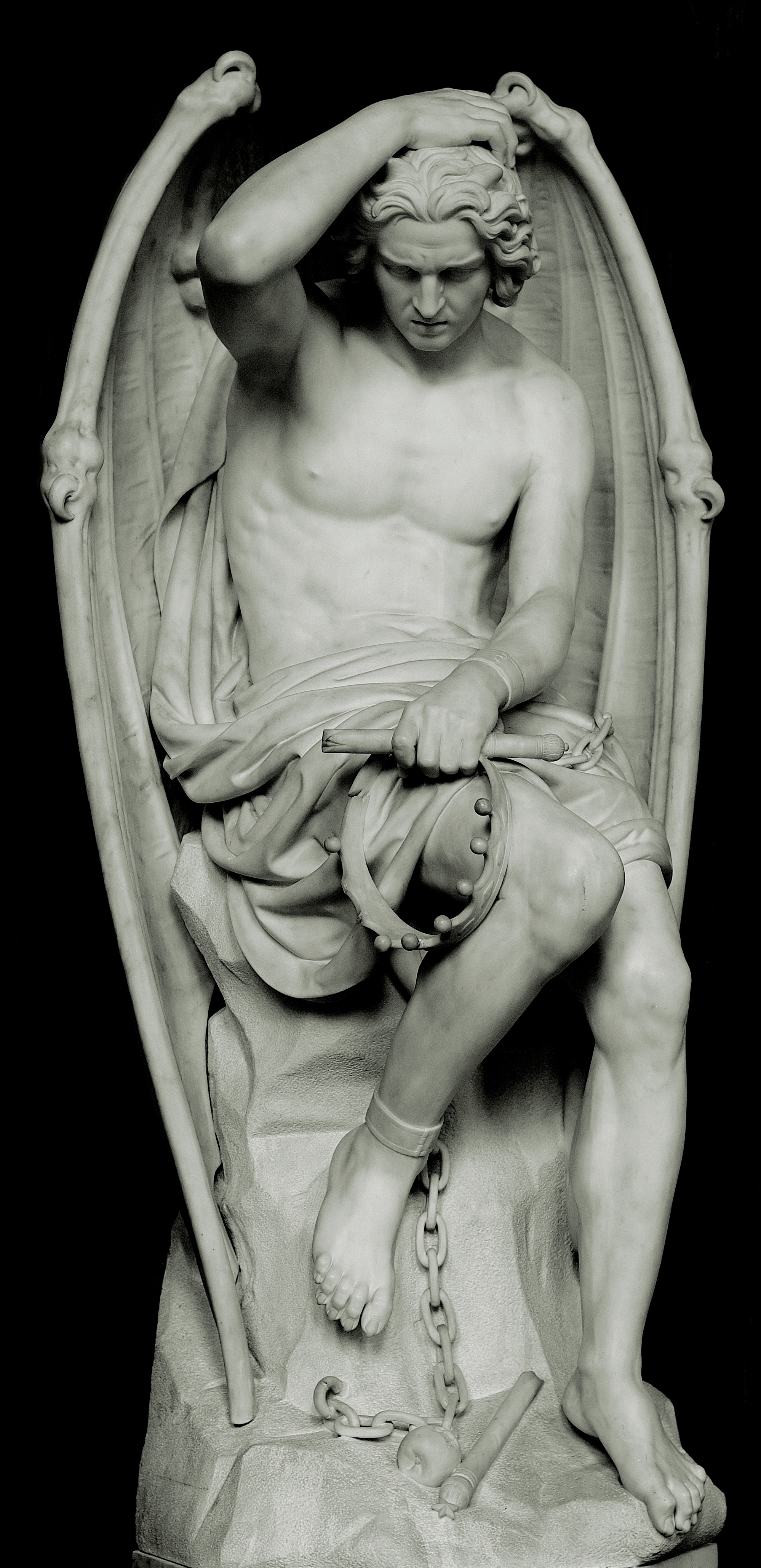 |
Le Génie du Mal (1848)
|
As one might perhaps expect, this idea of despair carries over into Paradise Regained as well. I was struck by a particular passage in Book III, where Milton described the tempter as "inly racked" (203). Satan remarks, "[A]ll hope is lost / of my reception into grace; what worse? (204-205). This again shows the conflict between Satan's emotions and his words, though in this instance, the reader understands a bit better the emptiness in his words; we realize that those same words which he's speaking are the words that rack his soul and conscience. The verb "to hope" in Latin is spero, and so de-spair then becomes a state wherein one is deprived of hope. This mirrors the words of Milton's adversary, who says "all hope is lost." He recognizes to some extent the futility of his own struggle, realizing that whether or not Christ reigns, Satan himself is still damned and that success will not bring him out of his despicable state.
Monday, November 11, 2013
Humility and "Active Passivity" in Paradise Regained

Subscribe to:
Posts (Atom)