Showing posts with label Lucifer. Show all posts

Saturday, November 23, 2013

Waving The Banner of Freedom For Personal Gain

Whew. Finally back into the swing of things. I've been really sick this week and am finally recovering so this is my attempt to begin catching up on my research work for my final paper.

In considering what to write my final paper on, I am drawn to a few ideas that have been floating around in my head for a while. I want to explore deeper the concepts from my last paper about freedom and submission (personified incorrectly by Satan and discovered by Eve). 

We live in a country founded on ideas drawn from Milton's of freedom and liberty from tyranny and many of the early founding fathers drew on these principles for their own writing and ideals. I feel that many have continued to hold on to the words of liberty but have lost the real meaning behind them or only used them as a face to help them find personal gain. Kind of like what Stanley Fish explains in his essay, "There Is No Such Thing As Free Speech"  In thinking about current situations and ideas, the words freedom and equality get thrown around recklessly and many seem to have a "down with the government I should get to do what I want cause I'm free" mentality. What are the consequences of seeking freedom through such means? I want to argue that this idea is what ruined Satan, and his actions and fate outline how this attitude actually destroys freedom. I don't want to focus so much on government, but the roles of citizens within the frame of government.

Is Freedom something achieved through government or is true freedom, freedom from government?
Basically there are two kinds of "freedom" one is negative and destructive and one provides progress and actual freedom for the individual. I found an awesome dissertation by following one of Professor Burton's ideas on his post that helped me discover the terms I was looked for to articulate the distinction.

Working thesis: Milton's On Tenure of Kings and Magistrates alongside his representation of Satan and Eve show the bounds in which freedom must be exercised to produce desired liberty. True freedom cannot be found without submission.

Still working to discover specifically what my conclusion is, but this is the frame work for my argument.


Tuesday, October 8, 2013

Lucifer Incarnate?

In his recent post, Greg claims that Lucifer was (consciously and/or unconsciously) writing autobiographically through the person of Lucifer in Paradise Lost. It's hard to miss the parallels between Milton's political tracts and Lucifer's speeches, so it's not surprising that Greg and others have come to this conclusion. However, I would argue - as I said in the comment section of Greg's post - that these parallels are, in the very least, Milton's attempt to explore how his generally virtuous rhetoric was turned to vicious ends during the Interregnum. Following this line of thought, I figured Cromwell to be the most likely counterpart to Paradise Lost's Lucifer. At present, I'm investigating the parallels between Cromwell and Lucifer. Evidence in favor of this view is already starting to stack up.

In upcoming posts, I expect I'll explore these topics further. For now, here are a few obvious parallels:
  1. The early careers of both Lucifer and Cromwell are marked by positive notoriety.
  2. Both figures proclaimed their intentions to be exclusively in the interest of liberty.
  3. While Cromwell's rhetoric may have began in earnest and Lucifer most certainly did not, both persons became more despotic than the monarchs they railed against once they gained power.
I should note that I don't think Milton intends this to be a simple Cromwell = Lucifer construct, but that he pulls extensively from Cromwell's character and career in creating Lucifer. In general, I think Lucifer (in PL) represents in aggregate those who, in one way or another, perverted the virtues that Milton espoused in his political writing.

Also, I watched an interesting biographical documentary produced by the BBC (above). If you were in class on Monday, many bits of info from the documentary will be old news, but I thought it offered some interesting detail about Cromwell as Lord Protectorate. Watch the first few minutes, and then jump to 26:00 if you don't have time for the whole thing.

Friday, October 4, 2013

Fleecy Things

I've had a lot of things on my mind, but as I've been thinking about redemption, I've wanted to revisit some of the thoughts that were going through my head when I wrote my sonnet, "Lamb Child." This is a paired sonnet to accompany the first. I'm not quite content with the start or the end yet, but in any case, you can decide what its all supposed to mean...

FLEECY THINGS
And now a solemn lay to thee rehearsed
Of stripèd beasts and shade-shorn fleecy things.
"Dear lamb, knowst thou who made thee in the first?"
And hearest thou that lark forlorn that sings
the night'ngale song? Learn from the blessed day
How heaven beckoned back the dayspring star
With closèd mouth in silent kyrie.
Behold the Tyger mute, stripes made to bear;
His regal pelt unparted stand and see!
Oh thou that grazed Elysian pastures fair,
Did he who made that slouching beast make thee?
     Lamb child, forsake desire, rebuke thy art
     And open now the pyx box of thy heart.

Tuesday, October 1, 2013

Via Purifico

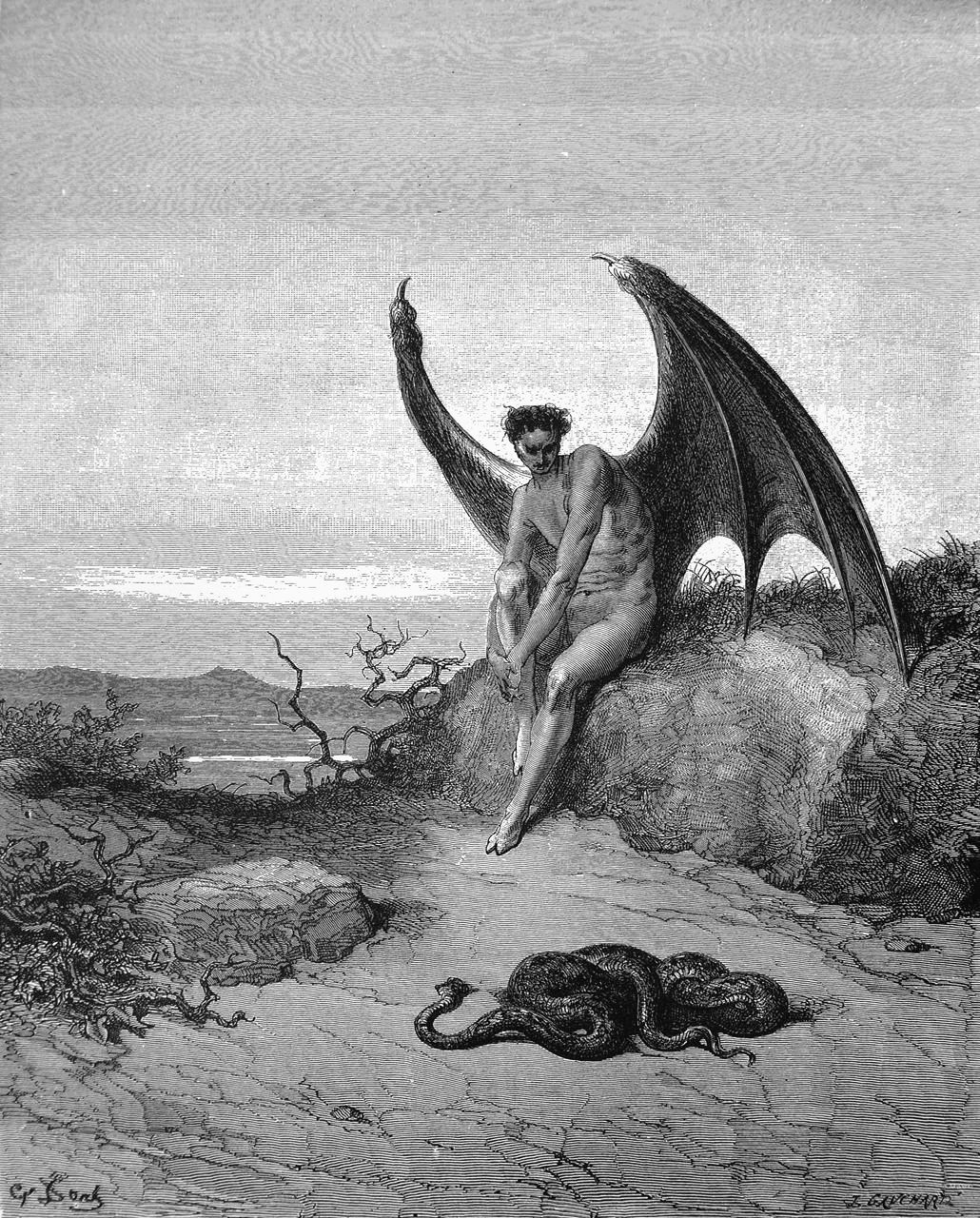
Lucifer, the Fallen Angel
by Gustave Doré
My first post on this blog looks into the literature as a tool for better understanding the concept of loss and, by extension, redemption; also in a recent sonnet, I address more specifically the subject of Satan's redemption (or the impossibility of such), but in any case, this is a topic that I wanted to spiral back to in light of recent readings in Books V-VI and in various academic sources.

In Paradise Lost, Satan himself seems convinced that his damnation is final, the road to redemption being blocked not only by his own weakness but also by a spiteful god. In Book V, the apostate angel laments:
But say I could repent and could obtain
By act of grace my former state; how soon
Would highth recall high thoughts, how soon unsay
What feigned submission swore: ease would recant
Vows made in pain, as violent and void.
For never can true reconcilement grow
Where wounds of deadly hate have pierced so deep:
Which would but lead me to a worse relapse
And heavier fall: . . . .(5:93-101)

Friday, September 27, 2013

Satan and Achilles, True Heroism

What makes a character a hero? Is it great accomplishments, firm morals, courage to fight through any situation? Talking about Satan as a hero figure in class on Wednesday made me realize that he is not much worse of an individual than many of the great heroes of the Greek epics. Think about Achilles, the great "hero" of the Iliad, was he really any better of an individual than Satan? He didn't rise from the depths of defeat, he groveled in it, quit when he was offended, and channeled his rage into nothing more but blind revenge. Achilles might have been the devil who would start a war with heaven anew. I never liked Achilles nor did I even seen any heroism in him at all, at least in his depiction in the Iliad.  It's an interesting comparison to think about. Satan's journey to earth also contains a lot of parallels to Odysseus's journey home. Both are portrayed as masters of trickery, deceit, and disguise. One was considered a great hero, while the other the reason for all unhappiness in the world. But are they really that different in character? I feel a little better sympathizing with Satan considering
Achilleus and Odysseus weren't the most heroic of figures. Oh and they were both favored by certain gods as well. Satan had nothing. Perhaps that may be the root of our sympathy for the devil in Milton's great tale. Satan has all odds stacked against him (like GOD) and yet still he finds the strength within to fight a losing battle. Thankfully none of us have to fight such a fight, nor do I think we would ever want to. If the devil can use revenge, hatred, and his suffering to push towards a hopeless goal, can't we fight on even stronger terms against him to do what is right and survive this mortal experience? Unlike Satan or Sisyphus, the rock we roll up the mountain of our life will reach the top, and we aren't the only ones pushing it.

Monday, September 23, 2013

A Paradise Lost by One

One of the things that has struck me most as I've been reading the first couple of books in Milton's Paradise Lost is the parallel of Satan's and Christ's relationship to their followers. You could say that I've thought a lot about salvation and damnation and what each means and how each is ensured, either by deference to virtue (Christ) or to sin (Satan), but a couple of pretty simple lines have had me thinking about how one figure (Christ or Satan) can figure into the fates of millions of individuals.

In the second book of Paradise Lost, Satan announces that he will "Through all the coasts of dark destruction seek / Deliverance for us all: . . . (2:464-465). The parallel to Christ's salvation here is, I think, more than apparent. Just as Christ is the author and finisher of our salvation--of our ascent back from a fallen condition--so also does Satan become the savior figure for those devils cast out of Heaven. But what really got to me was some lines that I came across among my annotations as I was reviewing the first book:
Millions of spirits for his [Satan's] fault amerced
Of Heav’n, and from eternal splendors flung
For his revolt . . . (1:609-611).
I had never really thought about this before, but just as man is saved by one supernal, vicarious act, so were those among that third part cast out for one singular act of selfishness. Each individual is, of course, responsible for his/her own actions and decisions, but would those "morning stars" and "sons of God" (Job 38:7) have relinquished their glory had not Lucifer stepped forward in defiance? After all, the Bible states that "all the sons of God shouted for joy" when the foundations of the earth were laid. Why then did they follow Lucifer, the light bringer that would cast them into darkness? What is the power of one to save or to damn?


Monday, September 16, 2013

Lamb Child

Remembrest thou that silent, starry floor,
Or thrones of ember, song, and silver light?
Recallest thou that bright empyrean shore,
And sphere-song that reproves the blackest night?
How art thou fallen from this sorr'wing sky
O Lucifer,           thou morning star and son
Of that bright glory forfeited, to fly
In proud rebellion earliest begun.
For thou in fatal flight didst fall to earth--
As Icharus, his waxy wings diswed--
No child of life, no son of mortal birth
But ashen babe of feral fires fed.
    Lamb child, far from thy long forgotten home
    How long in solemn darkness needst thou roam?

This sonnet is based loosely on Isaiah 14:12. One of the things that I am most excited about this semester in terms of literary content is trying to understand Lucifer better through Paradise Lost. Does God love him? Do we love him, and should we? On my mission, I cringed a little when an old man prayed for Satan, but I wonder if he was not so far from truth: "But I say unto you, Love your enemies, bless them that curse you, do good to them that hate you, and pray for them which despitefully use you, and persecute you" (Matt 5:44).