Showing posts with label mythology. Show all posts

Tuesday, October 1, 2013

知道是只道

To Know is the Only Way

(Zhidao shi zhidao)


Reading recently about Western perception of the Fall and Western roots for the word "knowledge" has been really eye opening. One thing we've talked about is that the Latin word, sapere, "to know" also means "to taste." We see this relevant in all sorts of Latin-based languages like French where the word "savoir" (to know) is so closely related to "saveur" (to savor or taste). Having recently come from a very different language, I wondered if there would be any connections between the two ideas in Chinese. While I found some similarites in the connotations of words regarding knowledge, there were some stark contrasts I'd like to bring to light.

As a background, for those of you not familiar with Chinese, each word is made up of one or two characters. Each character is given one syllable and has it's own meaning.  Each character, however, can be made up of many symbols (or radicals) each with its own, respective meaning. Let's look at the word "good."

The blue radical is the character for "woman," the red one means "man." When together, the word means "good," which makes literal the statement in Genesis 2:18 "It is not good for man to be alone."

There have been whole studies about the Chinese characters associated with the Fall. Believe it or not, the most commonly used characters nearly all have ties to the book of Genesis (examples include "man," "want," "west," "first," "talk," "create," and so many more). One that hadn't been researched, but that I'd like to pick apart for you is the character for "knowledge."

丿++ =

In this case, the blue radical means "to throw away," the gray, "heaven," the red "mouth." All three together mean "knowledge." Knowledge is what you get after you throw away heaven by tasting the fruit. And if you throw the character for "day"  日 in there, you get this: 


which means "wisdom." Genesis 2:17 "For in the day thou eatest thereof, thou shalt surely die." Perhaps it would have been wiser for Adam and Eve to heed this counsel? Or was it wiser for them to throw heaven away for this knowledge?

知者不言,言者不知. 
Those who know don't speak, those who speak don't know.

For those of you interested in seeing more characters with Christian origins, I highly recommend this PowerPoint.

Friday, September 27, 2013

Satan and Achilles, True Heroism

What makes a character a hero? Is it great accomplishments, firm morals, courage to fight through any situation? Talking about Satan as a hero figure in class on Wednesday made me realize that he is not much worse of an individual than many of the great heroes of the Greek epics. Think about Achilles, the great "hero" of the Iliad, was he really any better of an individual than Satan? He didn't rise from the depths of defeat, he groveled in it, quit when he was offended, and channeled his rage into nothing more but blind revenge. Achilles might have been the devil who would start a war with heaven anew. I never liked Achilles nor did I even seen any heroism in him at all, at least in his depiction in the Iliad.  It's an interesting comparison to think about. Satan's journey to earth also contains a lot of parallels to Odysseus's journey home. Both are portrayed as masters of trickery, deceit, and disguise. One was considered a great hero, while the other the reason for all unhappiness in the world. But are they really that different in character? I feel a little better sympathizing with Satan considering
Achilleus and Odysseus weren't the most heroic of figures. Oh and they were both favored by certain gods as well. Satan had nothing. Perhaps that may be the root of our sympathy for the devil in Milton's great tale. Satan has all odds stacked against him (like GOD) and yet still he finds the strength within to fight a losing battle. Thankfully none of us have to fight such a fight, nor do I think we would ever want to. If the devil can use revenge, hatred, and his suffering to push towards a hopeless goal, can't we fight on even stronger terms against him to do what is right and survive this mortal experience? Unlike Satan or Sisyphus, the rock we roll up the mountain of our life will reach the top, and we aren't the only ones pushing it.

Sunday, September 15, 2013

Pyrrha

In the first few lines of The Fifth Ode of Horus Milton addresses a figure named Pyrrha. This character ofGreco Roman mythology figures quite heavily in the rest of the poem, though only by reference, and knowing who she was helped me clear up some of the seemingly random imagery present later in the text.

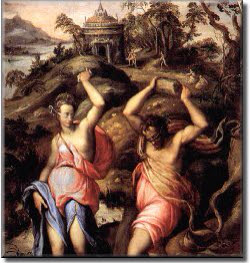
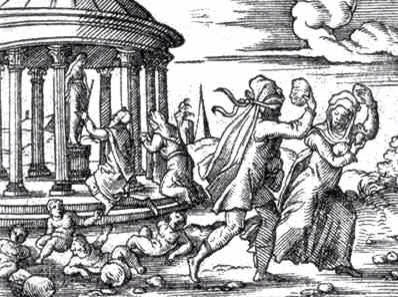
According to myth Pyrrha was a queen in Bronze Age Greece, ruling over the northern lands with her king Deukalion. Zeus, or Jove as the Romans called him, became angry with the violence and pride of the people and sent a "Great Deluge" to wipe them out. Prometheus warned Pyrrha and her husband of their impending doom, and the couple managed to escape the water's wrath and float on a small raft until Zeus' anger was appeased and he lowered the tides. Having survived the divine punishment, Pyrrha and Deukalion were charged with repopulating the Earth. The Oracle at Delphi told them to cast the bones of their mother over their shoulders, at which Pyrrha was understandably distressed, until her husband reasoned that Gaia, the Earth, was their mother and the stones must be her bones. They cast rocks over their shoulders, which turned into human beings, thereby saving humanity and ushering in a new age of prosperity.

While this is a lovely story all on its own, Pyrrha's place in The Fifth Ode of Horace can be seen as an explanation for Milton's references to water and storm. In lines six and seven we find "Seas / Rough with black winds and storms," in line eleven "flattering gales," and, perhaps the most striking, the last couplet's "My dank and dropping weeds / to the stern God of Sea."

I think one could posit that Milton intended the mood of the original story, the fear and loss of a couple bobbing about on a tiny little island, to echo in his own text. "O how oft shall he / On Faith and changed Gods complain" could allude to Pyrrha's sense of abandonment on her lonely raft. However, there is no complete loss of faith, as in the end the "Stern God of the Sea" is still called upon. Either way, understanding the backstory to these references helped give me some context in my reading, and I'm excited to see if Pyrrha pops up again in Milton's work.